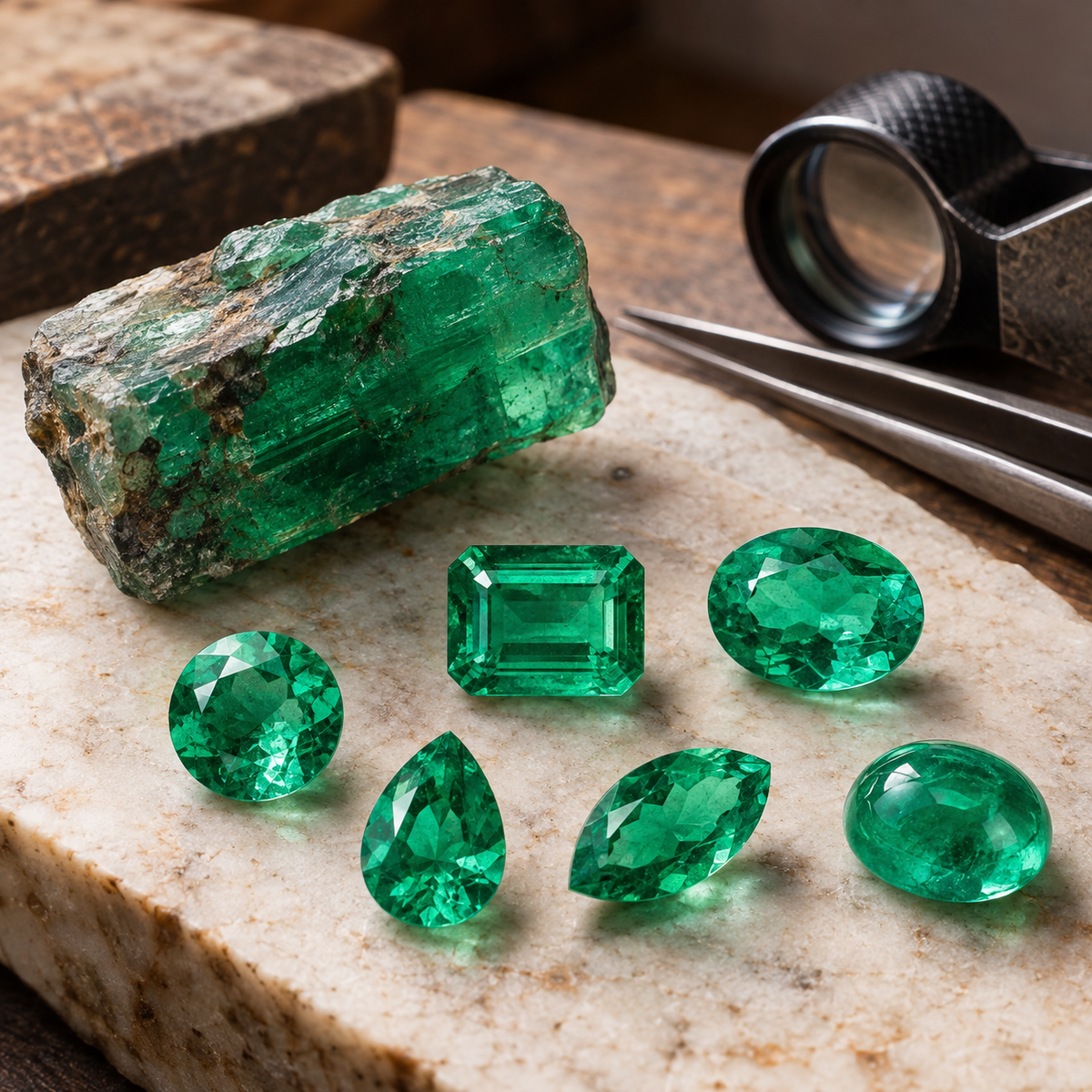
What Happens When a Rough Emerald Looks Unattractive?
When we think of a Colombian emerald, we probably imagine a green, brilliant, transparent stone ready to be turned into a piece of jewelry. However, before reaching a jewelry store, many emeralds look very different. Some resemble small, dark rocks, have irregular surfaces, display stains, or even make it difficult to recognize the green crystal hidden inside.
So, what happens when a rough emerald looks unattractive? Does it mean it has little value or cannot be transformed into a precious gemstone? The answer is more interesting than it might seem.
In this article, we explain why some rough Colombian emeralds do not catch the eye at first glance, which factors determine their potential, and how a stone that looks ordinary can become an extraordinary gemstone.
Why Can a Rough Emerald Look Like an Ordinary Rock?
Natural emeralds form under specific geological conditions through processes that may involve fluids rich in chemical elements and interactions between different types of rock. In Colombia, emerald deposits occur in distinctive geological environments that favored the formation of beryl crystals with their characteristic green color.
However, during their formation, emeralds do not necessarily develop smooth, shiny, or transparent surfaces. On the contrary, they may grow surrounded by other minerals and remain partially covered by the host rock.
For this reason, a rough emerald may have characteristics such as:
-
An irregular surface: The crystal may have rough edges, natural fractures, or uneven shapes.
-
A dark appearance: The rock surrounding the crystal may make it difficult to identify its true color.
-
Visible inclusions: Many natural emeralds contain small internal features that formed as they grew.
-
A color that is difficult to see: The green color may be hidden by the surrounding rock or difficult to appreciate under certain lighting conditions.
-
A small size: Some crystals are small and require careful evaluation to determine whether they can be used in jewelry.
Can an Ugly Rough Emerald Become a Valuable Gemstone?
Yes, it is possible. An emerald that does not look attractive in its natural state may reveal a crystal with good color and transparency when some of the surrounding rock is carefully removed.
Imagine finding a small green fragment within a dark matrix. At first glance, it may seem insignificant. However, after a proper evaluation, a specialist might identify a crystal that can be cut to produce a gemstone suitable for jewelry.
The result will depend on the emerald's actual characteristics, not just its external appearance.
Some of the most important factors include:
1. The Emerald's Color
Color is one of the fundamental aspects considered when evaluating an emerald. Its hue, saturation, and distribution are all examined. A crystal may look unimpressive while covered by rock but reveal a more attractive green color after careful preparation.
2. Transparency
Not all emeralds transmit light in the same way. Some are relatively transparent, while others appear more opaque. The available transparency influences the cutting possibilities and the final result.
3. Fractures and Inclusions
Emeralds may contain fissures, mineral inclusions, and other internal features. Their quantity, location, and extent can affect the crystal's durability, appearance, and ability to be worked without damage.
4. The Crystal's Size and Shape
A rough emerald may have considerable volume, but that does not mean all its material can be transformed into a faceted gemstone. The specialist must determine which parts of the crystal are usable and which cutting style would produce the best possible result.
5. Yield After Cutting
During the transformation process, material is removed to shape the gemstone and improve its appearance. As a result, a rough stone may eventually become a cut emerald that is much smaller than we originally imagined.
For this reason, an emerald's potential value is not determined solely by its original size.
What Happens During the Evaluation of a Rough Emerald?
Before deciding whether an emerald is worth working on, it is important to conduct a careful evaluation. This process helps determine whether the crystal has a realistic chance of becoming a gemstone suitable for jewelry.
1. The Rock Is Examined in Its Natural State
The first step is to examine its overall appearance, identify possible crystalline areas, and observe the characteristics of the surrounding matrix. Proper lighting can help reveal signs of a crystal, although a superficial examination alone cannot establish its quality.
2. The Crystal Is Identified
When there are indications of an emerald, the specialist examines its shape, color, and other characteristics. In some cases, gemological tools may be necessary to distinguish the material from other green minerals or rock fragments that could be mistaken for a gemstone.
3. Fractures and Inclusions Are Studied
Before working on the crystal, it is important to identify fractures that could compromise its integrity. A poor decision during extraction or preparation may cause a valuable section to break or significantly reduce the amount of usable material.
4. The Usable Material Is Estimated
The specialist considers the crystal's dimensions, orientation, color distribution, and the areas that may need to be discarded. This information helps estimate which cutting style is feasible and how much material can be preserved.
5. A Decision Is Made About Whether to Cut It
Not every rough emerald should be transformed into a faceted gemstone. Some may be better suited to cabochon cutting, while others are intended for mineral collections or are preserved in their natural state.
The decision depends on the available material and its intended purpose.
From an Unattractive Rock to a Cut Colombian Emerald
Transforming a rough emerald into a gemstone suitable for jewelry involves several stages, each of which influences the final result.
First, the crystal is identified and evaluated. Next, the best orientation for working on it is determined, taking into account color distribution, fractures, and usable material. The specialist then carries out the necessary preparation, cutting, and faceting, aiming to showcase the gemstone's characteristics as effectively as possible.
Finally, the emerald can be incorporated into a jewelry design, whether in yellow gold, white gold, rose gold, or combined with natural diamonds.
However, the process does not always result in a large, transparent stone. The outcome depends on the initial quality of the material and the decisions made throughout its transformation.
That is precisely why working with rough emeralds requires experience, patience, and a clear understanding of each crystal's characteristics.
How Can You Tell Whether a Rough Emerald Is Worth Buying?
If you are considering purchasing a rough emerald, especially if you intend to have it cut later, it is important to ask a few questions before making a decision. For example: What cutting options are available, and how much material might be lost during the process?
It is not possible to guarantee the outcome of cutting based solely on a photograph or a commercial description. If the purchase represents a significant investment, the most prudent approach is to request an in-person evaluation from a specialist experienced in rough gemstones.
It is also important to distinguish between a stone that shows potential and one whose value has already been supported by an appropriate evaluation.
Emerald By Love: Beauty at First Sight
In the world of Colombian emeralds, understanding a stone before working on it is just as important as recognizing its beauty once it is finished.
At Emerald By Love, we believe that understanding the origin, characteristics, and unique features of natural emeralds is essential for making informed decisions. If you would like to learn more about these gemstones, their transformation processes, and the factors to consider when purchasing them, our team can guide you in learning to appreciate each emerald beyond its initial appearance.
Paula Bonilla
Social Communicator and Journalist, Sergio Arboleda University, Colombia