Article: The Journey of a Colombian Emerald: From Rock to Jewelry

The Journey of a Colombian Emerald: From Rock to Jewelry
A Colombian emerald does not begin its story in a display case or jewelry store. Its journey starts much earlier, deep within the earth, where the right geological conditions allow these green beryl crystals to form.
From being extracted as rough rock to becoming a piece of jewelry, an emerald goes through several stages. Each one requires knowledge, care, and experience to make the most of the gem’s natural characteristics.
From the mine to your hands
1. It All Begins Underground
Colombian emeralds form in particular geological environments. In Colombia, some of the main deposits are located in areas such as Muzo, Coscuez, Chivor, and Gachalá.
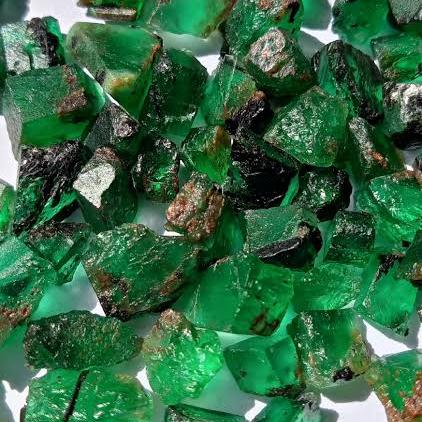
During their formation, emerald crystals can grow alongside other minerals. Pyrite, quartz, calcite, and carbonaceous materials may appear around the crystal, making a rough emerald very different from the gemstone we eventually see in a piece of jewelry.
That is why finding an emerald is not simply a matter of finding a green stone. First, the crystal must be identified and its characteristics carefully evaluated.
2. Extracting the Emerald
When working in a mining area, extraction aims to recover the material containing emerald crystals while avoiding unnecessary damage.
Depending on the deposit and the type of mining operation, different mining methods may be used. Once the material has been extracted, a selection process begins, during which the rocks are examined and potential crystals are identified.
At this stage, emeralds of different sizes, shapes, colors, and degrees of transparency may be found. Some are easy to recognize, while others remain partially hidden inside the surrounding rock.
3. From Rock to Rough Emerald
Once a crystal has been found, we are still not looking at a gemstone ready to be used.
The rough emerald must be carefully examined. Its shape, fractures, inclusions, color, and transparency help determine how it can be cut.
This is where experience plays an important role. Cutting an emerald is not simply about giving it an attractive shape. It also means making decisions that allow the material to be used efficiently while minimizing, as much as possible, the loss of the stone’s weight.
4. Cutting Transforms the Crystal
After the rough emerald has been examined, one of the most delicate stages begins: cutting.
The cutter must analyze the crystal’s orientation and internal characteristics before making each cut. A poor decision can significantly affect the final result.
Emeralds can be cut into different shapes, including emerald cut, oval, round, pear, cushion, or even custom shapes.
The emerald cut, for example, is a step cut that gets its name precisely from its traditional use for this gemstone.
5. Treatment Is Also Part of the Story
Many natural emeralds have fractures and internal characteristics resulting from their formation. For this reason, some may undergo treatments to improve their appearance.
One of the treatments traditionally used for emeralds is fracture filling with substances such as oils. The amount and nature of the material used may vary, which is why any treatment should always be clearly disclosed.
Treatment does not turn a natural emerald into a synthetic emerald. A gemstone can remain natural even after receiving treatment, as long as its origin and nature are correctly identified.
6. Evaluating the Gemstone’s Quality
Once cut, an emerald can be evaluated based on several characteristics.
Color is one of the most important factors, but it is not the only one. Transparency, cut, inclusions, size, the presence of treatments, and other gemological characteristics are also considered.
In Colombian emeralds, inclusions can also provide interesting information about the gemstone’s geological history.
That is why two emeralds of the same size can have very different values.
7. From Gemstone to Jewelry
Once the emerald has been selected, a new stage can begin: becoming part of a piece of jewelry.
This is where design, metal, and the other gemstones that will accompany the emerald come into play. It can be set in yellow, white, or rose gold of different karats and combined with diamonds or other precious gemstones.
An engagement ring, a pair of earrings, or a pendant can have completely different designs, but they all share the same idea: creating a piece that allows the natural characteristics of the gemstone to be appreciated.
8. A Piece That Keeps Its Origin
The journey does not end when the jewelry leaves the store. Each emerald retains characteristics connected to the place where it formed, the materials that surrounded it over millions of years, and the decisions made during its cutting and setting.
That is why there is much more behind a Colombian emerald than its color. There is geology, mining, selection, cutting, gemology, design, and craftsmanship.
From the Mine to Your Hands
At Emerald By Love, we believe that understanding an emerald’s journey helps you appreciate the jewelry it eventually becomes even more.
We work with natural Colombian emeralds and guide our clients through the process of selecting a gemstone and creating personalized pieces.
Because before becoming a ring, a pair of earrings, or a necklace, every emerald had its own story. And knowing that story gives the jewelry even more meaning.
Paula Bonilla
Social Communicator and Journalist, Sergio Arboleda University, Colombia