What Minerals Are Found with Colombian Emeralds?
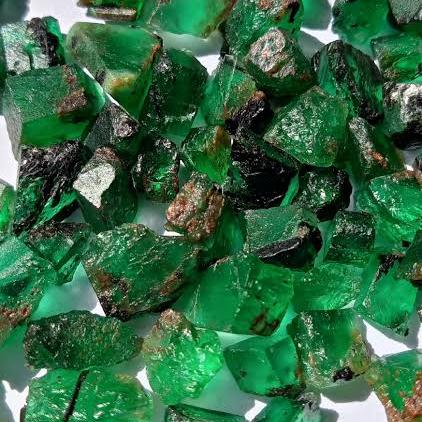
Anyone who has had the opportunity to see a Colombian emerald in its rough form will know that, during its formation, it grows alongside various minerals. Pyrite, quartz, and carbonaceous material are just some of them.
In this article, we explain how an emerald forms, which minerals can accompany the formation of this gemstone, how to identify them by sight, and whether they can increase an emerald's value.
How Does a Colombian Emerald Form?
To understand why an emerald is found alongside other minerals, we first need to understand that a gemstone does not form in isolation.
Colombian emeralds formed under very particular geological conditions, through the interaction of fluids rich in chemical elements with rocks deep underground.
The formation of an emerald requires, among other elements, beryllium, aluminum, silicon, and chromium or vanadium, which are responsible for many of the chemical characteristics and the green color of this variety of beryl.
During this process, fluids move through fractures and spaces within the rocks. Under certain conditions, the elements needed to form the crystal can combine and allow the emerald to grow.
And here is the interesting part: while the emerald is growing, other minerals may also form or remain around it.
That is why, when we find a rough emerald, we can see a kind of "geological history" of how it was formed.
What Minerals Are Found with Colombian Emeralds?
The geological environment of Colombian emeralds can contain different minerals. Some are easier to identify than others.
Pyrite
Pyrite is one of the minerals that can be found associated with Colombian emeralds.
Its metallic appearance and golden-yellow color make it relatively easy to recognize. For this reason, many people know it as "fool's gold," although it is naturally not gold.
When it appears near a rough emerald, it can form small crystals or masses within the rock. The presence of pyrite is interesting from a geological perspective, but it does not automatically mean that the emerald has a higher commercial value.
The price of an emerald mainly depends on characteristics such as its color, transparency, clarity, size, cut, origin, and treatments, as well as market demand.
Quartz
Quartz is one of the most common minerals in the Earth's crust and can also occur in geological environments associated with emeralds.
It is generally colorless, white, or translucent, although it can display different colors depending on the impurities and conditions in which it forms.
When we look at a rough emerald, quartz may appear as part of the matrix or in the areas surrounding the crystal.
As with pyrite, finding quartz alongside an emerald does not automatically mean that the gemstone is more valuable.
Its main interest lies in helping us understand the geological environment in which the stone formed.
Calcite
Calcite can also be found associated with Colombian emeralds. It is a mineral composed primarily of calcium carbonate and can occur in different forms and colors. In rocks associated with emeralds, it may appear as part of the veins and mineral structures formed during geological processes.
In some rough emerald specimens, calcite may be visible around the crystal, especially when the stone still retains part of the rock that surrounded it.
Albite and Other Minerals
Depending on the deposit and the specific geological conditions, other minerals can also be found associated with Colombian emerald mineralization.
These may include albite, along with other minerals that form part of the rocks and mineral veins.
This demonstrates something important: a Colombian emerald is not simply a green crystal that appears isolated underground. It is part of a much more complex geological system.
How Can You Identify These Minerals by Sight?
If you have a rough Colombian emerald in front of you, certain visual characteristics can provide clues about the minerals surrounding it.
For example:
Pyrite: it usually has a metallic yellow color and a shine similar to that of metal.
Quartz: it is generally seen in white, transparent, or translucent tones and can have a glassy luster.
Calcite: it can be white, transparent, or display different shades, and depending on its form, it may have a more opaque or pearly appearance.
Carbonaceous material: it generally has black, gray, or dark tones and looks different from crystalline minerals.
However, there is an important recommendation: identifying a mineral based solely on its appearance is not always enough.
Two minerals can look similar, and a rough rock can contain several different materials at the same time. For accurate identification, gemological and mineralogical testing may be used.
Do the Minerals Found with an Emerald Increase Its Value?
This is probably one of the most interesting questions. The short answer is: not necessarily.
The fact that an emerald is accompanied by pyrite, quartz, calcite, or other minerals does not, by itself, mean that it has a higher price. When an emerald is evaluated to determine its commercial value, different characteristics of the gemstone are considered.
Some of the most important include:
-
Color: the hue, saturation, and distribution of the green.
-
Clarity: the amount, type, and appearance of inclusions.
-
Transparency: how much light can pass through the stone.
-
Size and weight: usually expressed in carats.
-
Cut: when the stone has already been faceted.
-
Treatments: for example, the degree of fracture filling with substances such as oil.
-
Origin: a natural Colombian emerald may have particular interest in the market because of its origin.
-
Overall quality and the individual characteristics of each specimen.
Therefore, finding a small pyrite crystal next to an emerald does not automatically mean that the stone is more expensive.
So, Why Are These Minerals Important?
Although they do not necessarily increase the price of an emerald, the minerals that accompany it are very interesting.
For a geologist, gemologist, or emerald specialist, these mineral associations can provide information about the environment in which the gemstone formed.
They also help us understand why Colombian emeralds are so distinctive from a geological perspective.
In addition, when we look at a rough emerald that is still surrounded by its matrix, we can appreciate something that partially disappears after cutting and polishing: the gemstone's natural context.
It is like seeing a small part of its story before it becomes a piece of jewelry.
The Colombian Emerald: A Gemstone Within a Mineral World
One of the most interesting things about Colombian emeralds is that their story does not begin when someone finds and cuts them.
Long before becoming a ring, a pair of earrings, or a necklace, these crystals grew slowly within a geological environment where different minerals, fluids, and materials interacted.
Pyrite, quartz, calcite, albite, and carbonaceous material can all form part of this environment, although they do not necessarily appear together in every specimen.
That is why, when we look at a rough Colombian emerald, we are not simply looking at a green stone. We are seeing the result of a complex geological process that took place over millions of years.
And perhaps that is one of the most fascinating things about Colombian emeralds: each crystal carries with it a small part of the geological history of the place where it was formed, and at Emerald By Love, we help you discover it.
Paula Bonilla
Social Communicator and Journalist from Sergio Arboleda University, Colombia