What Do F1, F2, and F3 Mean in a Colombian Emerald?
Enhancing a Colombian emerald has become a common term when discussing these gemstones. Treating a gemstone does not change its natural origin; however, it does represent an enhancement that should be understood by anyone considering purchasing one.
In this article, we will explain what emerald enhancement is, what the process involves, what F1, F2, and F3 mean, how to identify whether an emerald has been enhanced, and how we can help you make a more informed purchase.
What Is Emerald Enhancement?
Enhancement, also known as clarity treatment, is a process in which a material is introduced into some of the fractures or fissures in an emerald that reach its surface.
Natural emeralds commonly contain inclusions, fractures, and other internal characteristics. In fact, these features are so common that they are part of the gemstone's natural appearance and are often referred to as the jardin, or "garden."
It is important to understand one thing: treatment does not remove the fractures that already exist in an emerald. Instead, it reduces their visibility by filling them with a material that has optical properties similar to those of the gemstone.
Why Are Emeralds Enhanced?
Emeralds are gemstones that can naturally contain numerous inclusions and fractures. For this reason, clarity treatment is common in the emerald trade.
The main purpose is to improve the stone's visual appearance, especially when surface-reaching fractures are particularly visible.
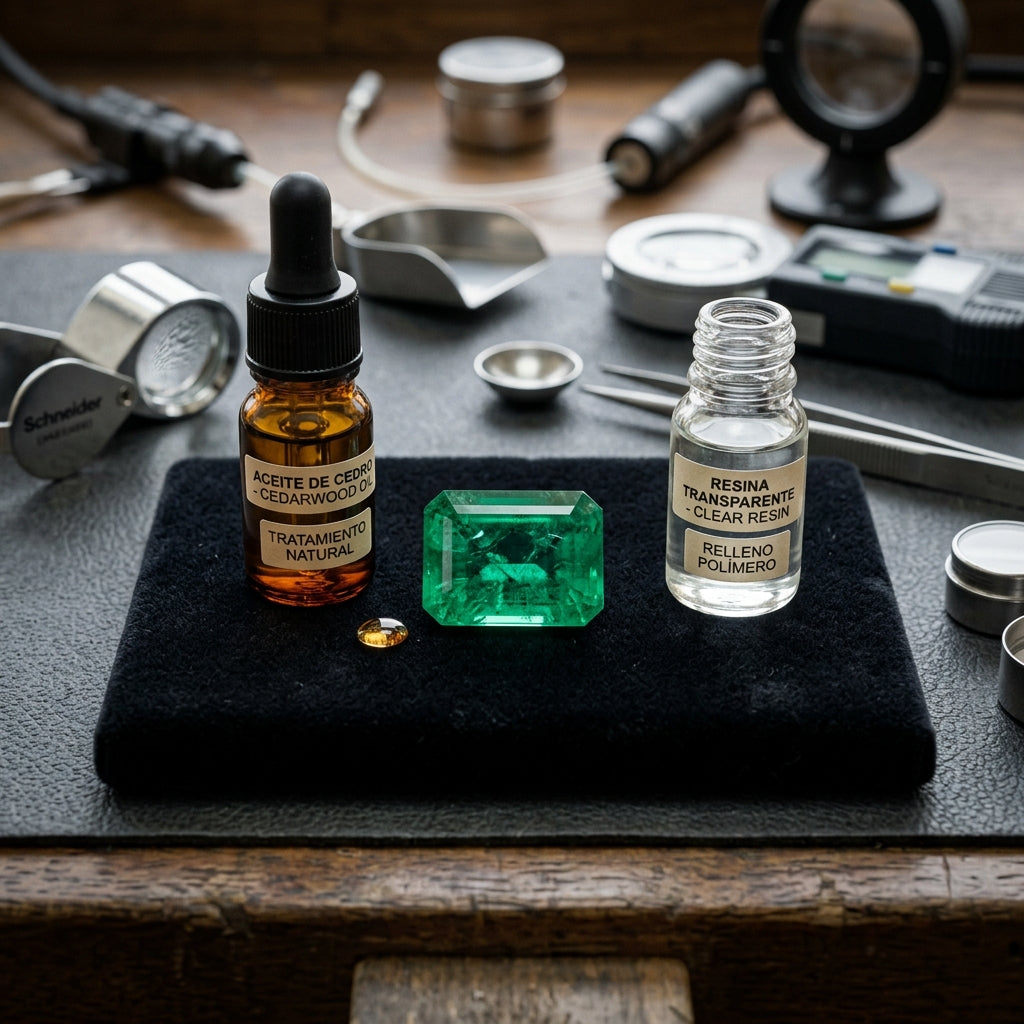
Materials that may be used include:
-
Oils
-
Waxes
-
Natural resins
-
Artificial resins
That is why, when buying an emerald, it is not enough to simply ask whether it is "treated." It is also important to know what type of treatment it has and the degree of enhancement.
What Do F1, F2, and F3 Mean in an Emerald?
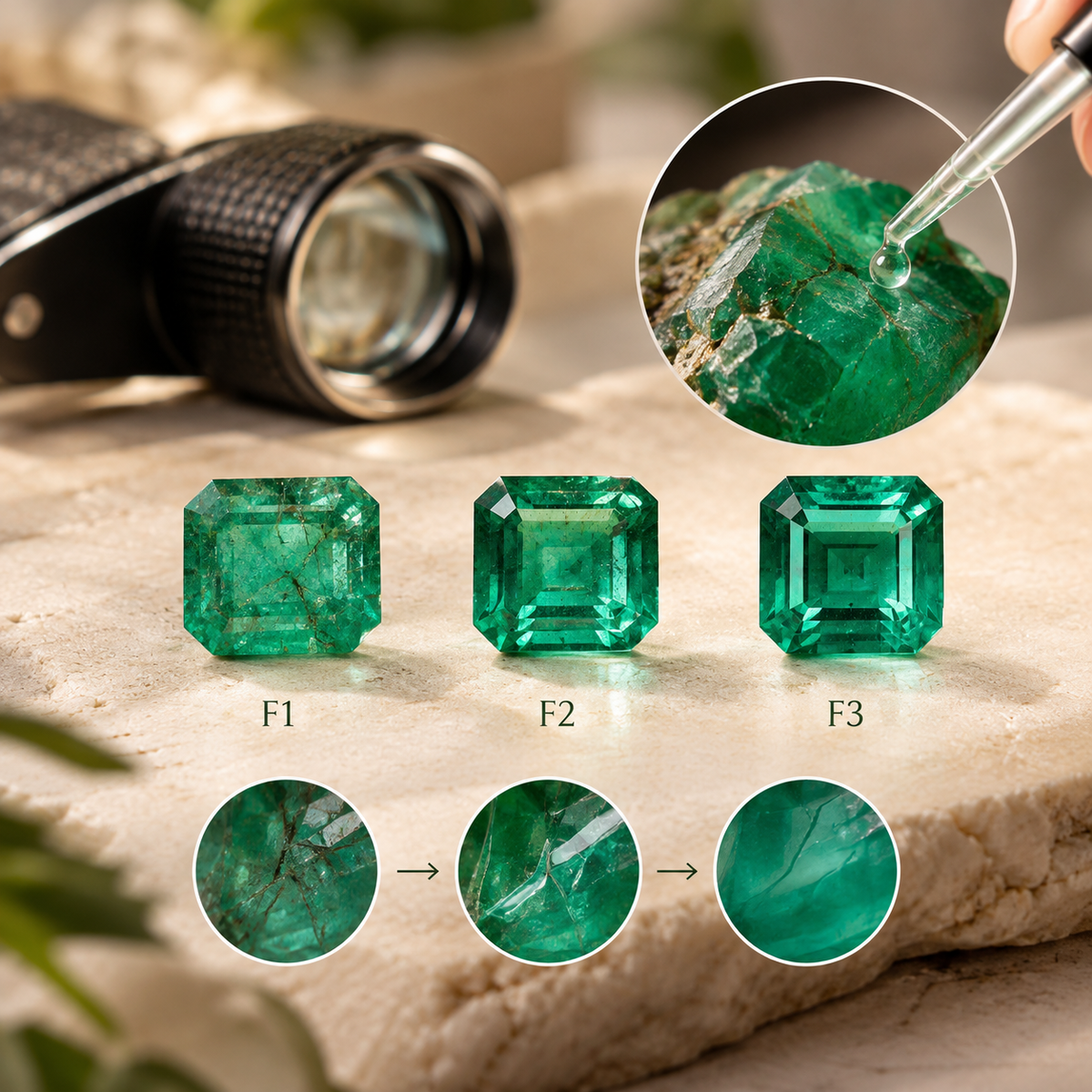
The F1, F2, and F3 categories are used to describe the degree of clarity enhancement in an emerald. The most commonly referenced grades are:
F1: Minor Enhancement
An emerald classified as F1 has a minor degree of clarity enhancement. This does not mean that the emerald is flawless or that it has no inclusions. An F1 emerald remains a natural gemstone with its own internal characteristics.
F2: Moderate Enhancement
F2 means that the degree of clarity enhancement is moderate. In this case, the treatment has a more noticeable effect on the appearance of the emerald than it does in an F1 stone.
The stone may contain an amount or distribution of filler material that has a moderate influence on its final appearance.
F3: Significant Enhancement
F3 corresponds to a significant degree of clarity enhancement. In this category, the treatment has a noticeable effect on the appearance of the emerald.
This does not mean that the stone is no longer natural. A natural emerald may receive a treatment after it has been extracted to improve its apparent clarity.
What matters is that the treatment is properly identified and disclosed to the buyer.
How Can You Tell If an Emerald Has Been Enhanced?
It can be difficult to determine this with the naked eye.
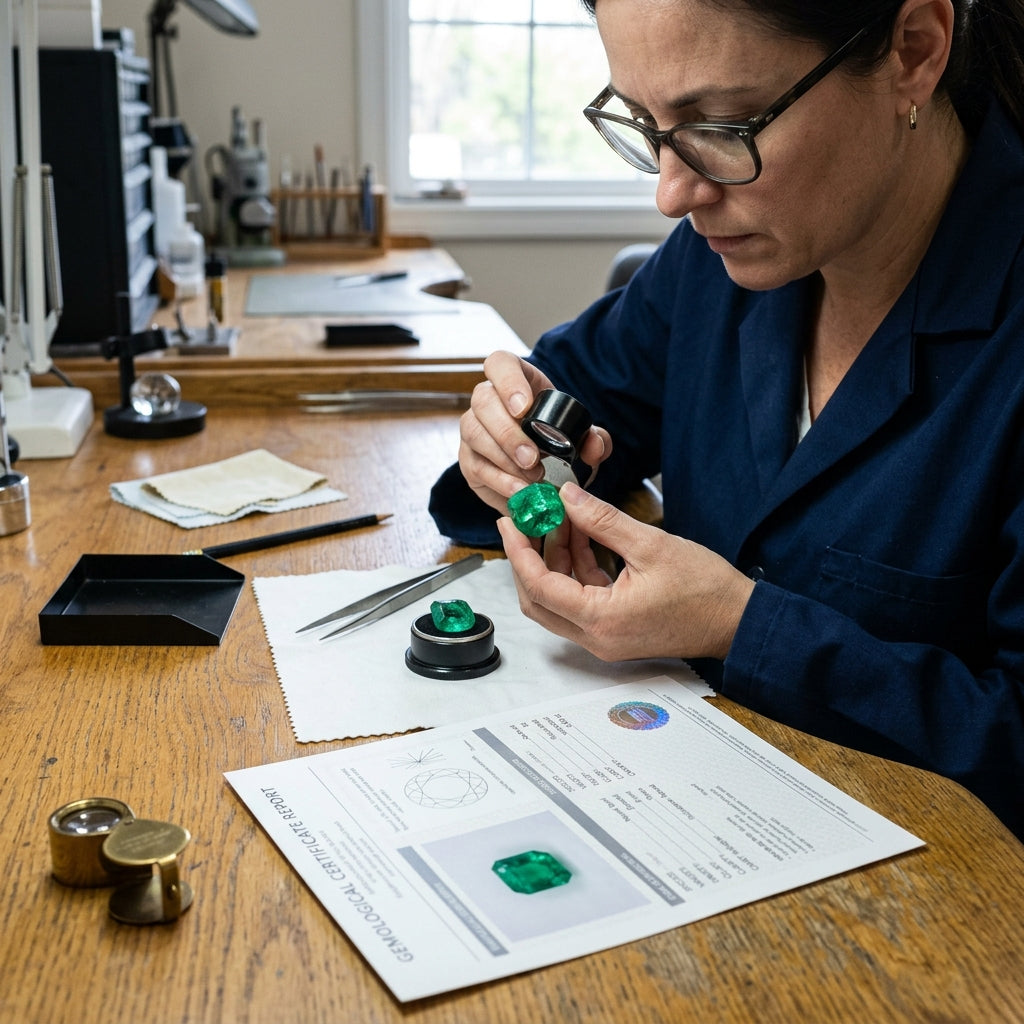
Some treatments can be detected by a gemologist using a loupe or microscope, but identification may require laboratory techniques depending on the stone and the material used.
Treated emeralds may display microscopic features associated with the filling process, such as certain optical effects or inclusions related to the treatment.
For this reason, we do not recommend trying to determine the treatment solely by looking at a photograph or using a loupe at home.
When treatment is an important factor in a purchase, a report from an independent gemological laboratory can provide much more reliable information.
Does Enhancement Mean That an Emerald Is Fake?
No. A natural emerald can receive treatment after it has been mined, cut, and polished.
The fact that an emerald has been enhanced does not mean that it is synthetic or laboratory-grown. The origin of the gemstone and the treatment it receives after extraction are two different things.
For example, an emerald can be:
Natural + Colombian + Treated
And still be a natural emerald.
Treatments and synthetic gemstones are two different concepts.
What Should an Emerald Certificate Say?
If you are purchasing a valuable emerald, a gemological certificate or report can help you better understand the stone.
Depending on the laboratory and the type of report, it may include information about:
-
Whether the stone is an emerald
-
Whether there are indications of treatment
-
The degree of clarity enhancement
-
The origin, when the laboratory is able to determine it
-
Additional information about the filling material
This is why simply asking, "Is it oiled?" may not be enough. The treatment can be more complex, and a laboratory report may provide additional information.
Does Treatment Affect the Value of an Emerald?
Treatment is one of the factors that should be considered when evaluating an emerald, but it does not determine value on its own.
Color, transparency, clarity, size, cut, origin, and other characteristics also influence the value of an emerald.
For this reason, it is not recommended to think simply:
F1 = expensive
F2 = medium
F3 = inexpensive
The reality is much more complex.
Two emeralds with the same degree of treatment can have significant differences in color, transparency, size, cut, and other characteristics.
What matters is understanding what you are buying and comparing gemstones that are genuinely comparable.
How Can Emerald By Love Help You?
Buying a Colombian emerald should not be about simply looking at a green gemstone and choosing the one that sparkles the most.
At Emerald By Love, we can help you understand the characteristics of each emerald, including its color, clarity, size, cut, and treatment, so you can make a more informed purchasing decision.
We work with natural Colombian emeralds and can explain, in simple terms, what the treatment of each stone means, the differences between one emerald and another, and which options may best fit your budget.
If you are looking for an emerald for a custom piece of jewelry, we can also guide you through the different options available before you make a decision.
Because knowing whether an emerald is F1, F2, or F3 is only one part of the story. What matters most is understanding the gemstone in front of you and knowing exactly what you are buying.
Paula Bonilla
Social Communicator and Journalist, Sergio Arboleda University, Colombia