How to Know if an Emerald Certificate Is Authentic?
Buying a Colombian emerald is an important decision, especially when you are considering a high-value gemstone. That is why, in addition to looking at its color, size, clarity, and origin, it is essential to understand the information provided in its gemological certificate.
A certificate can help you learn more about an emerald’s characteristics and support the information provided by the seller. However, simply having a document in your hands does not automatically mean that it is authentic or that it corresponds exactly to the gemstone you are buying.
So, how can you tell if an emerald certificate is authentic? What information should you check? And why is it so important to make sure that the document and the gemstone correspond to each other?
In this article, we explain the main aspects you should review before buying a certified emerald.
What Is an Emerald Certificate?
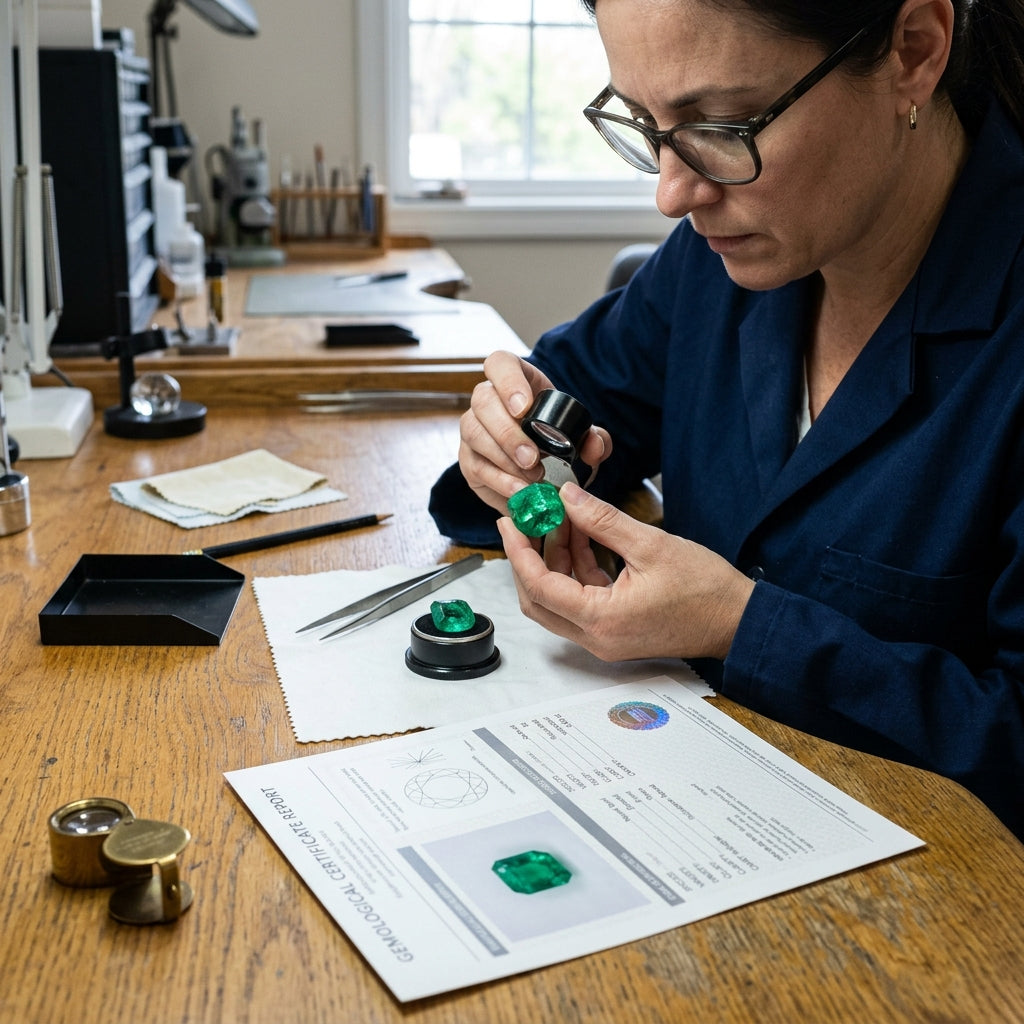
A gemological certificate is a document prepared by a specialized laboratory or institution that describes certain characteristics of a gemstone.
Depending on the laboratory and the type of report, it may include information such as:
- Gemstone type.
- Geographic origin, when it can be determined.
- Carat weight.
- Measurements.
- Color.
- Transparency or clarity.
- Treatments or degree of enhancement.
- Photographs.
- Report identification number.
It is important to understand that not all certificates contain exactly the same information. The scope of the analysis depends on the laboratory, the equipment used, and the type of report requested.
How Can You Check if an Emerald Certificate Is Authentic?
There are several points you can review. None of them should be considered in isolation; ideally, you should compare all the information on the certificate with the emerald you have in front of you.
1. Check Who Issued the Certificate
The first step is to identify the laboratory or institution that performed the analysis. A certificate should clearly indicate who issued it and provide enough information to identify the laboratory.
It is also advisable to research whether the laboratory has experience and recognition within the field of gemology.
2. Look for the Certificate Number
Gemological reports normally have a unique number or identification code. This number allows the document to be associated with the corresponding report and, in some cases, can be verified directly with the laboratory.
If the certificate includes a report number, you can ask the seller how it can be verified and whether the laboratory offers an online verification system.
3. Check Whether the Laboratory Allows Online Report Verification
Some laboratories offer tools on their websites that allow users to look up certain reports using the certificate number.
When this option is available, enter the number directly on the laboratory’s official website and compare the information displayed with the physical document.
Pay particular attention to:
- Report number.
- Gemstone type.
- Weight.
- Measurements.
- Description of the gemstone.
- Treatment, if indicated.
- Photographs, when available.
If the digital information does not match the certificate you have, it is a reason to pause the purchase and ask for an explanation.
4. Compare the Weight and Measurements
This is one of the most important points. The certificate may indicate the emerald’s carat weight and dimensions. These characteristics should be consistent with the gemstone you are buying.
For example, if the report states a weight of 3.00 ct but the emerald in front of you has clearly different characteristics, you should ask why.
The same applies to the measurements. A small difference may be related to measurement methods or rounding, but significant differences require an explanation.
5. Check Whether the Photograph Matches the Gemstone
Some certificates include a photograph of the emerald. If yours does, compare it carefully with the actual gemstone.
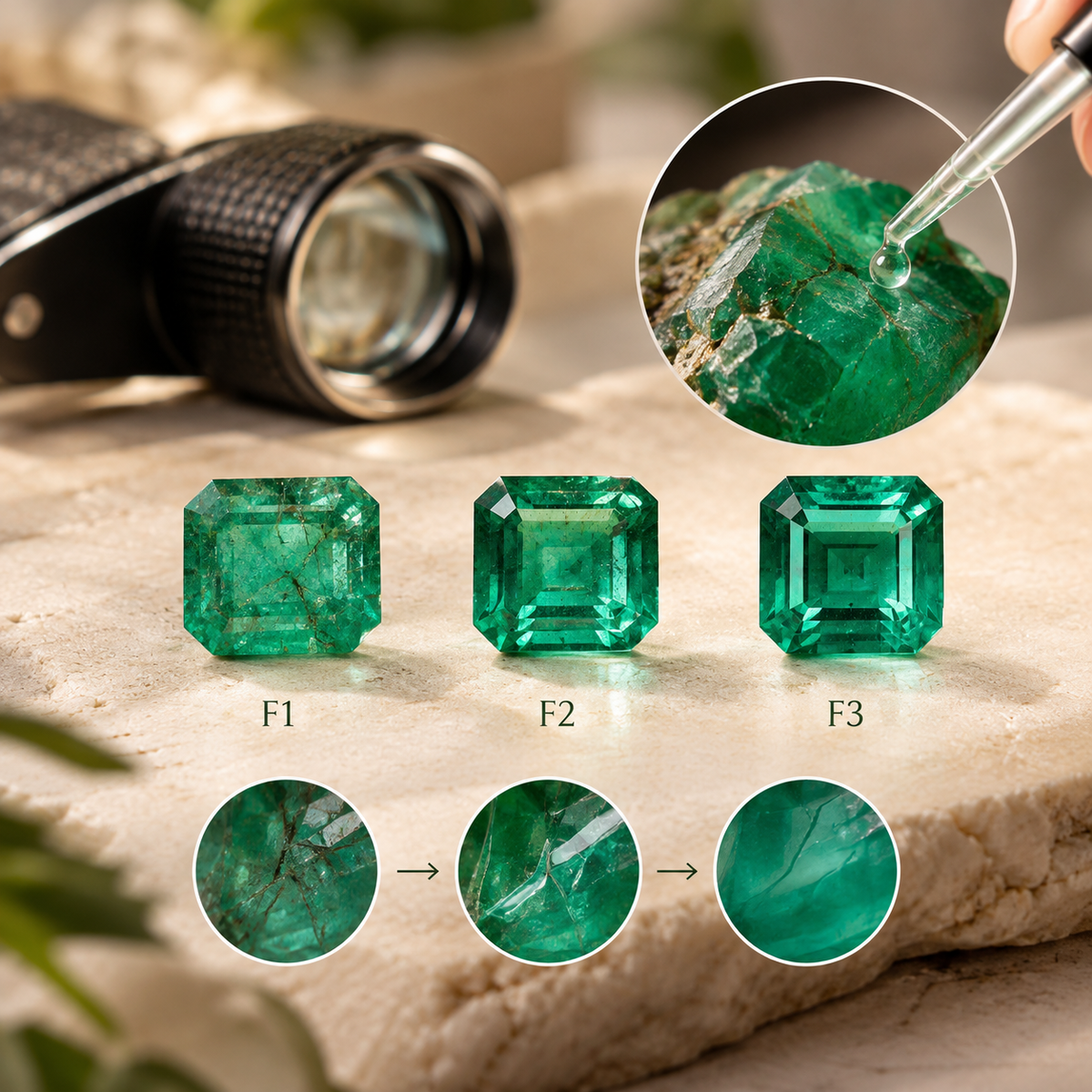
Emeralds can have distinctive internal characteristics, such as inclusions, fractures, structures, and patterns that can help distinguish one gemstone from another.
The photograph on the certificate should not be treated simply as decoration. It can be a useful tool for checking whether the document corresponds to the gemstone you are examining.
6. Examine the Internal Characteristics
Inclusions are an important part of identifying many emeralds.
A natural emerald may have internal characteristics resulting from its formation. Their distribution, shape, and appearance can help a gemologist study the gemstone.
For this reason, when a certificate includes a description of internal characteristics or a photograph, it is important to compare that information with the gemstone.
This does not mean that a buyer has to identify every inclusion on their own. That is what gemologists and specialized laboratories are for.
7. Check What the Certificate Says About Treatment
In the case of emeralds, this point is especially important.
Emeralds can have fractures and cavities that reach the surface. Some emeralds receive treatments intended to improve their appearance, such as filling fractures with certain materials.
The certificate may indicate whether the gemstone has been treated and, depending on the laboratory, may specify the type or degree of treatment.
Does a Certificate Make an Emerald More Valuable?
Not necessarily. A certificate can provide information and confidence during a purchase, but an emerald’s value does not depend solely on having a document.
Two gemstones with the same carat weight can have very different values because of their gemological characteristics.
What If the Certificate Appears to Be Authentic but Does Not Match the Gemstone?
Do not ignore the difference. If the certificate number is correct but the weight, measurements, photograph, or characteristics of the gemstone do not match, it is best to pause and request an explanation.
There may be a legitimate reason, such as the certificate belonging to another gemstone from the same lot or an administrative error. However, this should be clarified before making the purchase.
Is It Necessary to Buy an Emerald with a Certificate?
Not every emerald sold on the market necessarily comes with an individual gemological certificate. However, for certain purchases, especially when dealing with higher-value gemstones, having a report from a specialized laboratory can provide important information to help you make an informed decision.
It is also important to distinguish between a gemological certificate and a commercial document issued by the seller. Both may serve different purposes.
If you have questions, ask which institution performed the analysis and exactly what information the document supports.
What Do We Do at Emerald By Love Regarding Certificates?
At Emerald By Love, we work with natural Colombian emeralds and believe that understanding a gemstone’s characteristics is an important part of making an informed purchase.
That is why, in addition to discussing the color, size, clarity, cut, and characteristics of each emerald with you, we can guide you through the gemological information available for the gemstone you are considering.
Depending on the gemstone and your needs, we can also help you understand its origin, characteristics, and any treatment or enhancement that should be taken into consideration.
Our goal is for you not to buy an emerald simply because someone tells you it is Colombian or because it comes with a document. We want you to understand what you are buying and why.
Paula Bonilla
Social Communicator and Journalist, Sergio Arboleda University, Colombia