The Challenges of Buying a Colombian Emerald
Buying a Colombian emerald can be a fascinating experience, but it can also be a real challenge, especially for those who are unfamiliar with the world of gemstones.
Unlike other luxury products, there is no single price chart that determines how much an emerald should cost. Every stone is different, and factors such as color, transparency, inclusions, treatment, origin, cut, and weight can considerably affect its value.
Moreover, when it comes to Colombian emeralds, origin is particularly important. Mining regions such as Muzo, Chivor, and Coscuez have a long-standing tradition, and each origin can present distinctive characteristics.
Why Can Buying a Colombian Emerald Be Difficult?
1. Recognizing a Natural Emerald
One of the first challenges is knowing whether you are actually looking at a natural emerald.
The market includes natural stones, synthetic stones, imitations, and materials that have been treated to significantly improve their appearance. For someone without experience, distinguishing between them simply by looking at the stone can be extremely difficult.
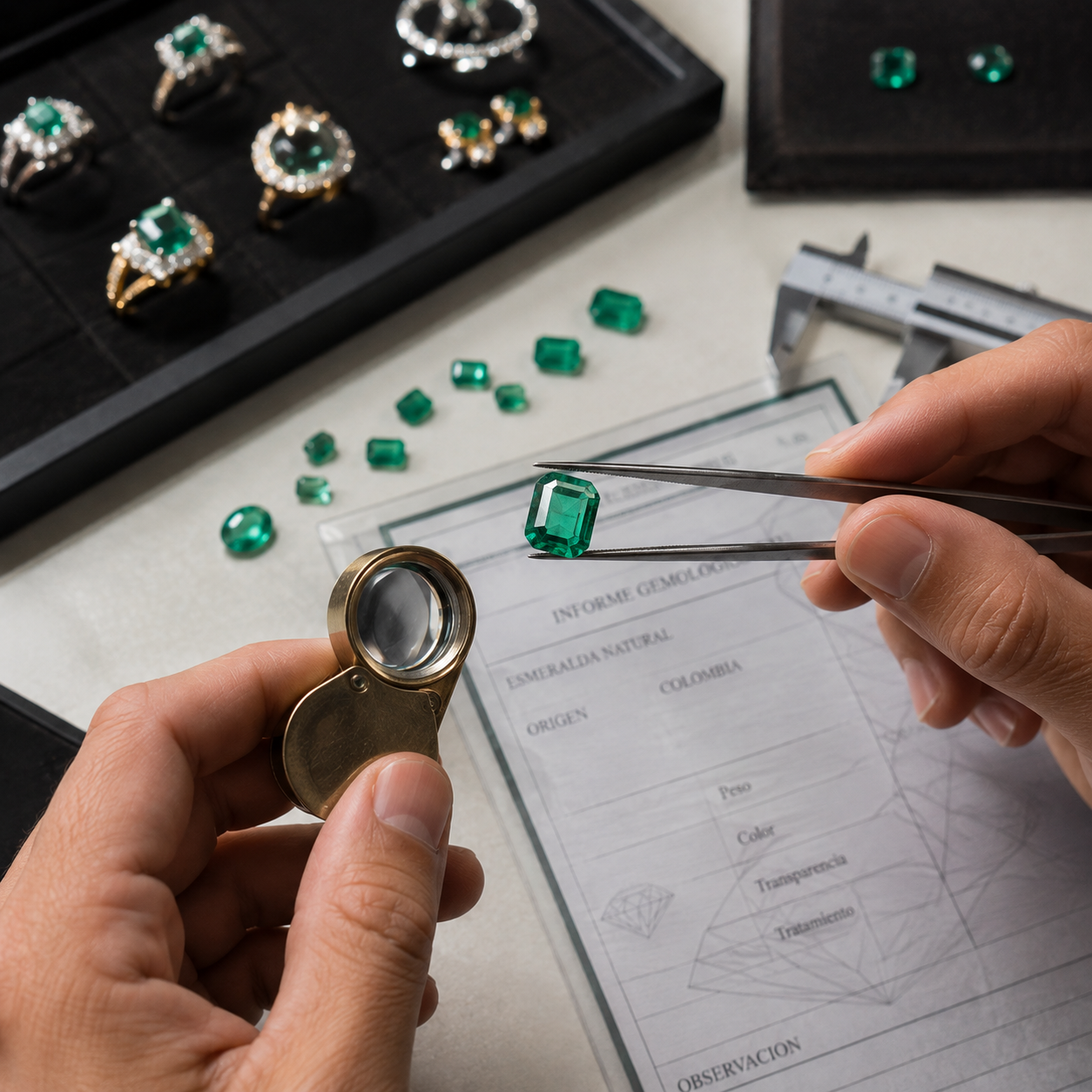
That is why, when a purchase represents a significant investment, it is advisable to work with a specialized seller and request gemological documentation indicating characteristics such as the nature of the gemstone and, when applicable, its origin and treatment.
2. Understanding the Price of an Emerald
Another major challenge is understanding why two emeralds with the same weight can have completely different prices.
An emerald should not be evaluated based solely on its carat weight. Color, tone, saturation, transparency, cut quality, inclusions, and treatment all influence its value.
For example, a smaller emerald with exceptional color and good transparency may be considerably more valuable than a larger stone with inferior characteristics.
This is one of the reasons why comparing emeralds solely by price per carat can lead to misleading conclusions.
3. Learning to Interpret Inclusions
The famous inclusions found in emeralds, popularly known as their “garden,” can create a lot of confusion among buyers.
Unlike many other gemstones, natural emeralds commonly contain inclusions. In fact, inclusions are part of the identity of many emeralds and can help demonstrate that a stone is natural.
However, not all inclusions have the same impact on value. A stone may have a beautiful garden while maintaining good transparency, whereas others may contain fractures or inclusions that significantly affect their appearance and durability.
The key is not necessarily to look for a completely clean emerald, but rather to learn how to evaluate the type of inclusions it contains and how they affect the stone.
4. Understanding Treatments
Treatment is probably one of the aspects that raises the most questions among buyers.
Many emeralds receive treatments to improve their appearance, particularly through substances used to fill fractures. According to Muzo Emerald Colombia, more than 95% of emeralds are treated with natural oils or polymers.
This does not mean that a treated emerald is fake.
A natural emerald can receive treatment and still remain a natural gemstone. What matters is knowing what treatment it has received and, whenever possible, its degree of treatment.
Emeralds with little or no treatment generally command higher values because of their rarity.
5. Verifying Colombian Origin
Simply being offered a stone described as “Colombian” should not be enough.
Geographic origin can be an important factor in the valuation of an emerald, particularly when dealing with high-quality stones. For significant purchases, documentation and gemological reports therefore become especially important.
Some mining operations also have their own traceability systems. For example, Muzo Emerald Colombia describes a system that records information related to extraction and allows the stone to be traced from its origin through commercialization.
6. Finding a Trusted Seller
Perhaps one of the biggest challenges is not the stone itself, but finding the right person to buy it from.
Buyers should feel comfortable asking questions:
-
Is the emerald natural?
-
What is its carat weight?
-
What is its origin?
-
Has it been treated?
-
What type of treatment did it receive?
-
Does it have a certificate or gemological report?
-
Does the price refer only to the gemstone, or does it include the jewelry?
-
Is an invoice and purchase documentation provided?
A professional seller should be able to explain the characteristics of the stone without pressuring the customer to make an immediate decision.
7. Don't Rely Solely on Photographs
Photographs can be useful for making an initial selection, but they do not always show an emerald exactly as it appears in person.
Lighting, camera angle, and image processing can considerably change the perception of color and transparency.
Whenever possible, it is therefore advisable to observe the stone under different lighting conditions and from multiple angles.
8. Finding the Right Balance Between Budget and Quality
Not every buyer is looking for the same type of emerald.
Someone looking for a piece of jewelry for everyday wear may prioritize a good balance between color, size, and price. A collector, on the other hand, may be willing to pay significantly more for uncommon characteristics, such as exceptional saturation, high transparency, large size, or minimal treatment.
That is why, before beginning your search, it is important to define what you are looking for and how much you are willing to invest.
How Can You Buy a Colombian Emerald More Safely?
The best strategy is to educate yourself before making a purchase.
First, establish a budget. Then, learn how to evaluate the main characteristics of an emerald: color, clarity, transparency, cut, weight, and treatment.
Compare several stones, not just their prices. Two emeralds can have the same weight and completely different values because of their gemological characteristics.
For a high-value purchase, consider requesting a report from a recognized gemological laboratory. It is also important to keep the invoice and all documentation related to the stone.
And above all, remember something fundamental: a Colombian emerald is not purchased solely for its carat weight; it is purchased for the combination of its characteristics.
The Real Challenge: Knowing What You Are Buying
The biggest challenge when purchasing a Colombian emerald is not finding a green stone.
It is learning to recognize what makes a particular emerald special.
Its color, transparency, garden, cut, treatment, origin, and even the way light travels through the stone are all part of a story that cannot be reduced to a simple price per carat.
Buying an emerald should be an experience in which the buyer understands what they are purchasing and why that particular stone has its value.
Emerald By Love: Knowledge Before Purchase
At Emerald By Love, we believe that purchasing a Colombian emerald should be an experience based on knowledge, trust, and authenticity.
Our goal is to bring buyers closer to the fascinating world of Colombian emeralds, explaining the characteristics of each stone and helping them find a gemstone that suits their tastes, needs, and budget.
Because behind every Colombian emerald lies much more than a beautiful green color: there is a story, an origin, a selection process, and a unique piece of nature.
Paula A. Bonilla
Social Communicator and Journalist from Universidad Sergio Arboleda in Colombia.