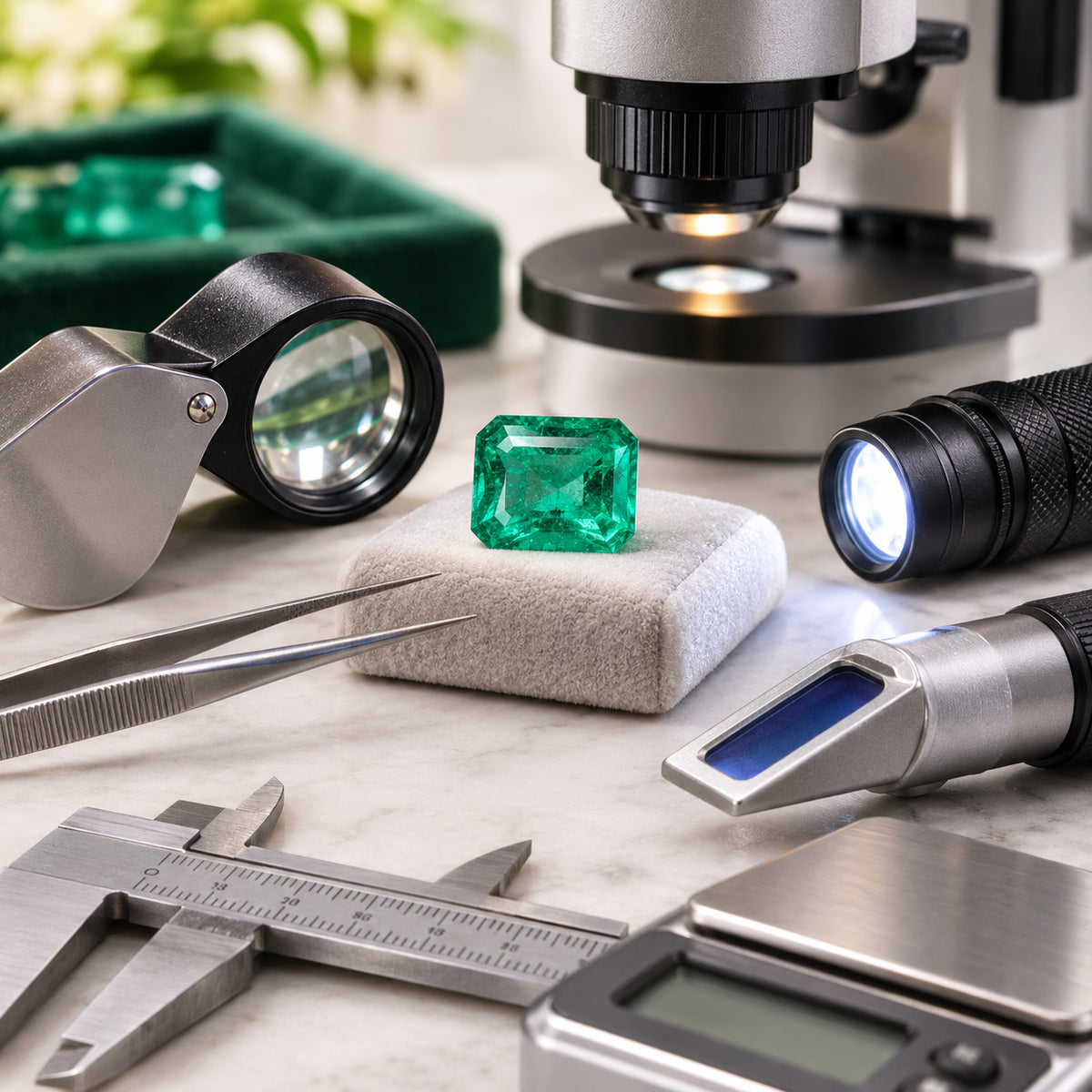
Glossary of Colombian Emerald Terms
Colombian emeralds have unique characteristics that make them special in the world of gemstones. Their origin, color, transparency, inclusions, and treatment processes are all part of a gemological vocabulary worth understanding, especially if you are thinking about purchasing an emerald, creating a custom piece of jewelry, or starting a collection.
But do you know what terms such as jardin, cut, carat, saturation, or treatment mean? In this glossary, we have gathered some of the most commonly used terms in the world of Colombian emeralds to help you better understand these gemstones and learn what to consider when choosing one.
Essential Terms You Should Know About Emeralds
1. Geographic Origin
This refers to the location where an emerald was formed and mined. Colombia is internationally recognized for its emerald deposits, particularly in regions such as Muzo, Coscuez, Chivor, and Gachalá.
2. Natural Emerald
An emerald is a variety of the mineral beryl that forms through natural geological processes. Its characteristic green color is primarily associated with the presence of chromium and, in some cases, vanadium.
3. Beryl
Beryl is the mineral family to which emeralds belong. Its chemical composition consists of beryllium aluminum silicate. Depending on the elements present in its structure, beryl can occur in different colors.
4. Inclusions
These are materials, crystals, liquids, gases, or small internal features trapped inside an emerald during its formation. They are common in these gemstones and can provide information about their growth and geological origin.
5. Jardin
This is the term used in jewelry and gemology to describe the collection of internal inclusions found in an emerald. These can create patterns, tiny fractures, and unique formations that give each stone its individual appearance.
6. Cut
The cutting process involves transforming a rough emerald into a gemstone with defined facets and proportions. A good cut aims to make the best use of the material, distribute the color, and achieve an attractive overall appearance.
7. Rough Emerald
This is an emerald in its natural state after extraction, before undergoing cleaning, sorting, and cutting processes. It may have irregular shapes, natural surfaces, and internal characteristics that determine how it will be worked. Depending on its formation, some rough emeralds may be referred to as morralla, canutillo, or macla.
8. Carat (ct)
A carat is the unit of measurement used to express the weight of gemstones. One carat equals 0.2 grams. It is important to remember that two emeralds with the same carat weight may look different in size because of their proportions and cuts.
9. Saturation
This describes the intensity or purity of an emerald's color. A stone with higher saturation displays a more intense green, while lower saturation can make its color appear more muted.
10. Tone
This refers to how light or dark an emerald's color appears. Some stones have lighter green hues, while others display deeper, darker shades.
11. Transparency
This is the ability of light to pass through an emerald. It can range from relatively transparent stones to those with a more translucent appearance or inclusions that limit the passage of light.
12. Luster
Luster describes the appearance of light reflected from an emerald's surface. It depends on factors such as polishing, cutting, and the gemstone's natural characteristics.
13. Oil Treatment
This is one of the traditional treatments used to improve the appearance of certain emeralds. It involves introducing a substance, generally colorless oil, into surface-reaching fissures to make them less visible.
14. Resin
Resin is a substance that may be used to fill fractures in some emeralds. Depending on the type of material and the procedure used, it can have different effects on the gemstone's appearance and stability.
15. Untreated Emerald
An untreated emerald is a gemstone that has not received clarity-enhancement treatments, such as oil, resin, or other substances. Its appearance reflects its natural characteristics.
16. Treated Emerald
This is an emerald that has undergone a process intended to visually modify or improve certain characteristics, particularly the appearance of its fissures. It is important to know which treatment was applied and the extent of the treatment.
17. Degree of Treatment
This is a classification that describes the amount of filler material used to improve an emerald's clarity. Gemological laboratories may use categories such as none, insignificant, minor, moderate, and significant, although terminology can vary between laboratories.
18. Pleochroism
This is an optical property that allows different color shades to be observed in a gemstone depending on the direction from which it is viewed. Emeralds can display variations in green when observed from different angles.
19. Fracture
A fracture is a break or discontinuity within a gemstone. It may be superficial or internal and should be carefully evaluated because certain fractures can affect an emerald's durability.
20. Calibrated Stone
This is a cut emerald with specific measurements designed to fit particular jewelry settings. Calibrated stones make it easier to use them in rings, earrings, bracelets, and other jewelry pieces.
21. Emerald Cut
This is a rectangular or square cutting style with beveled corners and step-cut facets. Although it takes its name from the emerald gemstone, this cut is also used for other precious stones.
22. Gemstone Cutter
A gemstone cutter is the specialist responsible for transforming a rough emerald into a finished gemstone. Their experience is essential for making the best use of the material, preserving weight, and achieving good color distribution.
23. Cutting Yield
This refers to the relationship between the weight of a rough emerald and the weight of the finished gemstone after cutting. A considerable amount of material may be lost during this process to achieve the appropriate shape and proportions.
24. Deposit
A mineral deposit is a geological area where natural concentrations of minerals are found. Colombia has several emerald-producing regions, each with its own geological characteristics.
25. Gemological Certificate
This is a document issued by a specialized laboratory that provides information about a gemstone's characteristics. Depending on the laboratory and the service requested, it may include identification, weight, measurements, treatments, and an opinion regarding its geographic origin.
Why Is It Important to Know These Terms?
Understanding gemological terminology allows you to better understand what you are purchasing and ask more specific questions before making a decision.
For example, two emeralds may have the same carat weight but differ significantly in color, transparency, inclusions, cut, and treatments.
That is why, when choosing a Colombian emerald, we recommend paying attention to the following:
-
Origin: Ask whether there is information supporting its Colombian origin.
-
Color: Observe its tone, saturation, and green color distribution.
-
Transparency: Evaluate how light interacts with the gemstone.
-
Inclusions: Remember that they are part of an emerald's natural characteristics, but they should also be carefully evaluated.
-
Treatment: Request clear information about any substances used to improve its appearance.
-
Cut: Examine its proportions, polish, and how effectively the rough material has been used.
Conclusion: Every Emerald Has Its Own Language
Colombian emeralds are much more than green gemstones. Each one has a geological history, internal characteristics, and unique features that influence its appearance and value.
Learning these terms is a great first step toward appreciating these gemstones and making informed decisions when purchasing a piece of jewelry.
At Emerald By Love, we believe that getting to know an emerald also means learning to appreciate what makes it unique. That is why we work with natural Colombian emeralds and guide our clients throughout the selection and jewelry creation process.
Paula Bonilla
Social Communicator and Journalist, Universidad Sergio Arboleda, Colombia