How to Use Tools for Colombian Emeralds
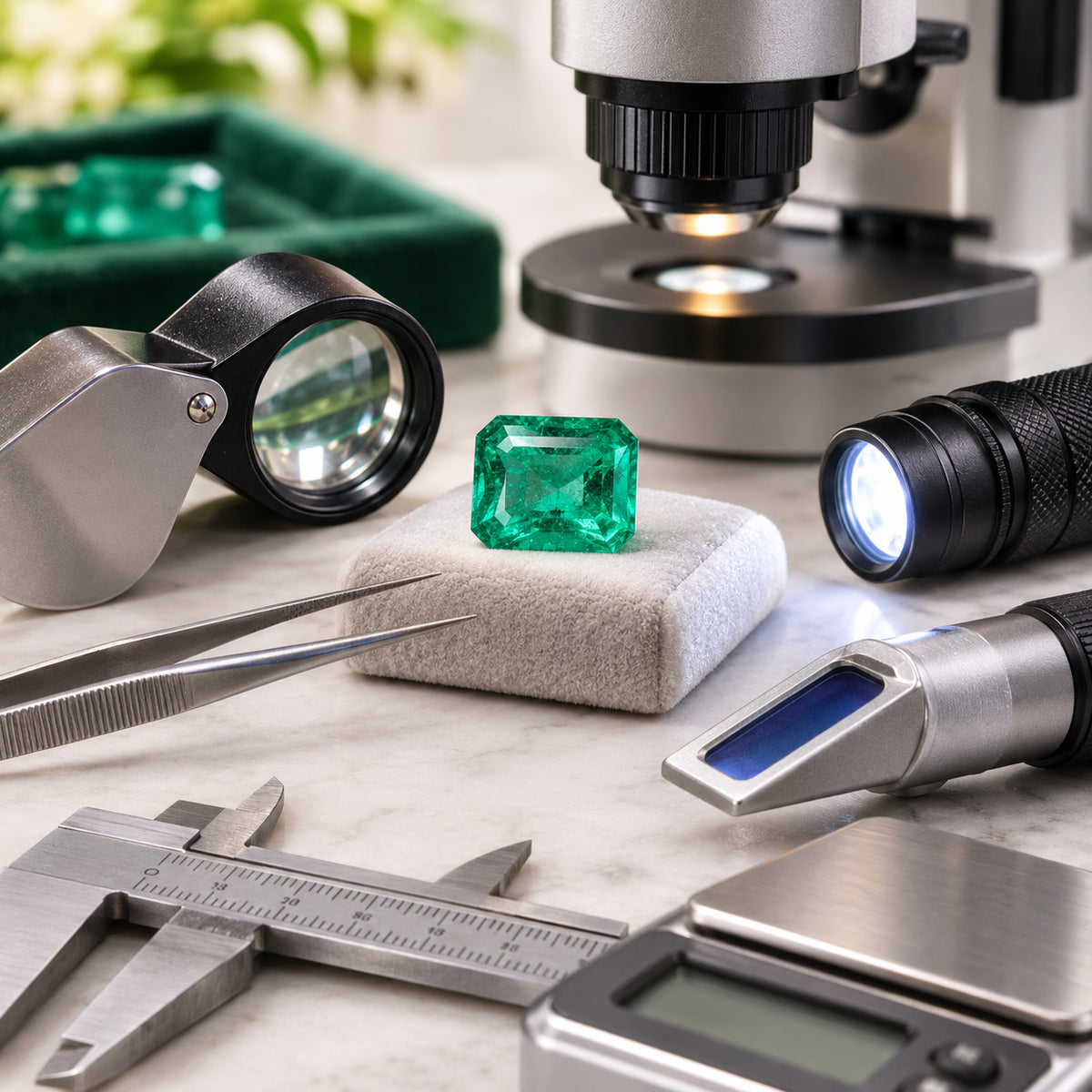
Although a Colombian emerald may seem like a simple gemstone to examine at first glance, understanding its characteristics requires specialized instruments. Some tools allow you to observe its inclusions, others help identify its optical properties, and some are designed to hold or work with gemstones safely.
If you are just beginning to learn about Colombian emeralds, understanding what each tool is used for can help you become more familiar with these gemstones and handle them with greater care.
In this article, we explain the most commonly used tools, how they work, and the recommendations you should keep in mind before using them.
Tools for Examining Colombian Emeralds
1. 10x Gemological Loupe
The 10x loupe is one of the best-known tools in the gemstone industry. It is used to examine details that are not always visible to the naked eye.
When examining Colombian emeralds, it allows you to observe:
-
Internal inclusions, commonly known as gardens.
-
Small cracks or fractures.
-
Surface characteristics.
-
Possible signs of treatments or fillers.
-
Cutting and polishing details.
Tips for using it:
-
Find a place with good lighting.
-
Hold the loupe close to your eye and slowly bring the emerald toward it until you achieve focus.
-
Avoid touching the gemstone's surface with the loupe.
-
Observe the emerald from different angles to identify its internal characteristics.
-
Clean the lens with a special cloth to prevent dust from affecting your observations.
A 10x loupe is an excellent tool for becoming familiar with the natural characteristics of an emerald. However, observing an inclusion alone is not enough to determine a gemstone's geographical origin or authenticity.
2. Gemological Tweezers
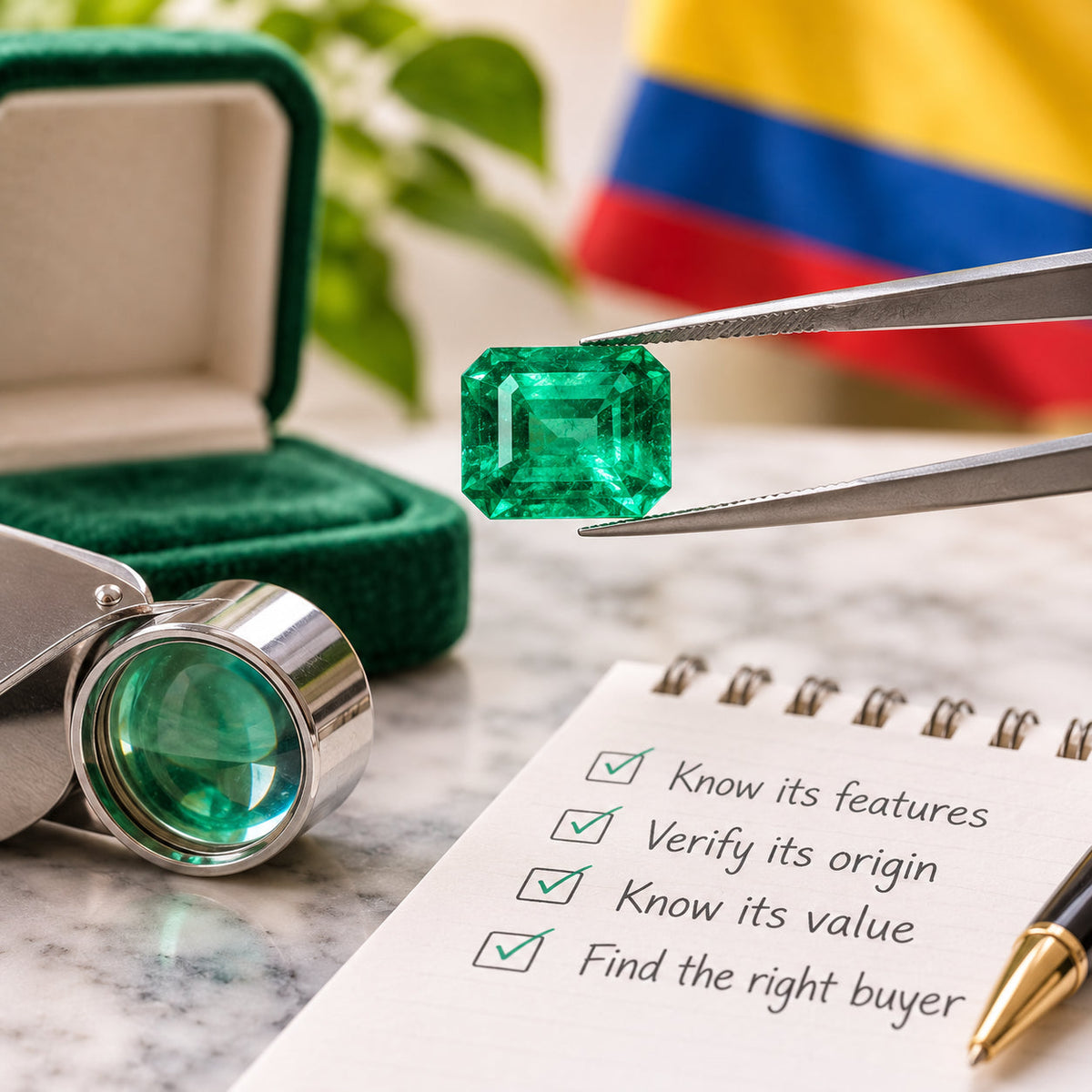
Tweezers are used to hold gemstones and make it easier to examine them from different angles. They are especially useful for gemologists, jewelers, and gemstone dealers who need to inspect an emerald without constantly handling it with their fingers.
There are different types, including fine-tip tweezers, tweezers with protected tips, and specialized gemstone tweezers.
Tips for using them:
-
Choose tweezers that are suitable for the emerald's size and shape.
-
Hold the gemstone gently without applying too much pressure.
-
Avoid gripping areas with fractures or delicate edges.
-
Work over a clean, padded surface.
-
Keep the gemstone away from the edges of the table.
An important recommendation: If you do not know how to properly hold an emerald with tweezers, it is better not to attempt it. Improper handling can cause the gemstone to slip, fall, or even fracture. If you have no experience, use your clean hands over a padded surface or ask someone with gemological knowledge for assistance.
Remember that emeralds may contain natural inclusions and fractures that require special care when handling them.
3. Gemological Microscope
A microscope is an essential tool for examining the internal and external characteristics of an emerald in greater detail.
Unlike a loupe, it allows you to work with different magnification levels and lighting systems, making it easier to study inclusions and other distinctive features of the gemstone.
With a gemological microscope, you can observe:
-
Mineral inclusions.
-
Internal fissures and fractures.
-
Crystal growth characteristics.
-
Evidence of treatments.
-
Surface and cutting details.
Tips for using it:
-
Carefully place the emerald on the microscope's platform.
-
Start at a low magnification and gradually increase it.
-
Use overhead lighting to examine the surface.
-
Try transmitted lighting to study internal characteristics.
-
Avoid moving the platform abruptly or hitting the gemstone.
A microscope provides valuable information, but correctly interpreting what you observe requires gemological knowledge.
4. Gemological Flashlight or Light Source
Lighting is essential when examining an emerald. The same gemstone can display different shades and characteristics depending on the type of light, its intensity, and the angle from which it is viewed.
Gemological flashlights and other lighting sources make it possible to examine a gemstone's transparency, color, and certain internal characteristics.
Tips for using it:
-
Use a high-quality white light source.
-
Observe the emerald from different angles.
-
Avoid excessively bright lights that make examination difficult.
-
Compare the gemstone under different lighting conditions.
-
Do not use heat sources to illuminate it.
It is important to remember that a photograph or an observation under a single light source does not necessarily represent an emerald's true color.
5. Gemological Refractometer
A refractometer is an instrument used to measure the refractive index of a gemstone. This value describes how light behaves as it passes through a material.
It is a tool used in gemology to help identify different mineral species and complement other analyses.
In the case of emeralds, it provides information about their optical properties, which can be compared with the expected values for beryl.
Tips for using it:
-
Make sure the instrument is clean and properly calibrated.
-
Use the contact liquid recommended for the equipment.
-
Position the gemstone correctly on the measuring surface.
-
Take the reading according to the manufacturer's instructions.
-
Carefully clean the instrument after use.
Not all emeralds allow for an easy reading, especially when their shape, size, or cutting characteristics make proper contact with the refractometer difficult.
6. Precision Scale
Weight is one of the important factors when evaluating an emerald. In gemology, it is usually expressed in carats (ct), with one carat equivalent to 0.2 grams.
Precision scales make it possible to determine a gemstone's weight before or after cutting. They are particularly important for gemstone dealers, cutters, and jewelers.
Tips for using it:
-
Place the scale on a stable surface.
-
Make sure it is calibrated.
-
Use a suitable container to prevent the gemstone from rolling.
-
Check that the measurement unit is set to carats.
-
Avoid placing wet or dirty gemstones on the weighing platform.
Remember that weight alone does not determine an emerald's value. Color, transparency, cut, inclusions, treatments, and other factors must also be considered.
7. Gemological Caliper
A caliper is used to measure an emerald's dimensions, generally its length, width, and depth.
It is a commonly used tool among jewelers and gemstone dealers because it helps determine a stone's proportions and identify what type of setting would best accommodate it.
Tips for using it:
-
Use a caliper designed for gemstones.
-
Measure the length, width, and depth.
-
Do not close the tips tightly against the emerald.
-
Avoid applying pressure to the edges and fragile areas.
-
Record the measurements for future reference or jewelry designs.
These measurements are particularly useful when creating a custom piece of jewelry.
General Recommendations for Handling Colombian Emeralds
Knowing which tools to use is important, but understanding when and how to use them is equally essential. If you are just beginning to work with emeralds, keep these recommendations in mind:
1. Do not use tools you do not know how to handle.
Before using tweezers, microscopes, or measuring instruments, learn how they work. An improperly used tool can damage a gemstone that may be very valuable.
2. Work on a safe surface.
Use a clean, stable, and preferably padded table. This reduces the risk of losing or fracturing an emerald if it falls.
3. Avoid applying pressure.
Emeralds may contain natural inclusions, fissures, and fractures. Do not squeeze them with tweezers or use instruments that could put pressure on their edges.
4. Keep your tools clean.
Dust, grease, and residue can affect observations and measurements. Clean your instruments according to each manufacturer's recommendations.
5. Do not confuse observing with identifying.
A loupe, flashlight, or filter can help you understand certain characteristics of an emerald, but these tools do not replace a complete gemological analysis.
6. Seek professional advice.
If you own a valuable emerald or need to determine its origin, treatments, or authenticity, the best option is to consult a qualified gemologist or a specialized laboratory.
Do You Need All These Tools to Understand an Emerald?
Not necessarily! If you are just beginning to develop an interest in Colombian emeralds, a 10x gemological loupe can be a good starting point for observing their inclusions and characteristics.
However, if your goal is to identify, evaluate, or trade emeralds, you will need more specialized knowledge and different instruments.
Each tool serves a specific purpose, and its results must be interpreted together with other findings. There is no single instrument that can reveal every characteristic of an emerald.
Get to Know Colombian Emeralds with Emerald By Love
The world of Colombian emeralds goes far beyond their distinctive green color. Understanding their inclusions, optical properties, origin, and transformation processes allows you to appreciate all the work and knowledge behind each gemstone.
At Emerald By Love, we work exclusively with natural Colombian emeralds and have a family tradition spanning more than 40 years in the industry. From understanding rough emeralds to transforming them into fine jewelry, we recognize the importance of every detail.
If you are considering purchasing a Colombian emerald, creating a custom piece of jewelry, or learning more about these precious gemstones, our team is here to assist you.
Paula Bonilla
Social Communicator and Journalist, Universidad Sergio Arboleda, Colombia