What Questions Should You Ask a Colombian Emerald Seller?
Buying a Colombian emerald can be an exciting experience, but it is also a decision that deserves careful consideration. Not all emeralds have the same color, clarity, size, origin, or treatment, and these factors can influence their value.
If you are thinking about buying one, asking the right questions can help you understand exactly what you are purchasing. You do not need to be a gemologist: with a few simple questions, you can get important information before making a decision.
Questions to Ask a Colombian Emerald Seller
1. Is the emerald really Colombian?
This should be one of the first questions you ask. Colombia is known for its natural emeralds, particularly those from mining regions such as Muzo, Coscuez, Chivor, and Gachalá.
Ask directly:
-
Is the emerald Colombian in origin?
-
Which region or mine does it come from?
-
Can you provide documentation supporting its origin?
Origin can be an important factor for buyers who are specifically looking for a Colombian emerald.
2. Is it a natural emerald?
It is important to confirm that you are buying a natural emerald and not a synthetic or lab-created stone.
You can ask:
“Is this a natural emerald extracted from a mine?”
A specialized seller should be able to clearly explain what type of stone they are offering.
3. Has it received any treatment?
Emeralds can naturally contain inclusions and fractures. For this reason, many emeralds receive treatments to improve their appearance, particularly with substances such as oils or resins.
Ask:
-
Has the emerald been treated?
-
What type of treatment did it receive?
-
What substance was used for the treatment?
-
Is the treatment stated on the certificate?
You do not necessarily have to rule out an emerald because it has been treated. What matters is knowing what type of treatment it has received and making sure this information is disclosed transparently.
4. Does it have a gemological certificate?
If the stone has significant value, ask whether it comes with a gemological certificate.
A certificate can provide information about characteristics such as:
-
Gem species and variety.
-
Origin, when the laboratory is able to determine it.
-
Treatments.
-
Weight.
-
Color and internal characteristics.
-
Identification of the stone.
You can also ask which laboratory issued the certificate, since not all documents provide the same scope or level of information.
5. How much does the emerald weigh?
An emerald's weight is normally expressed in carats (ct).
But remember that two emeralds with exactly the same weight can have very different prices. Color, transparency, inclusions, cut, treatment, and other factors can also influence their value.
So, do not rely only on:
“This one is larger, so it is more expensive.”
Ask what characteristics justify the difference in price.
6. How would you describe its color?
Color is one of the most important aspects when visually evaluating an emerald.
You can ask:
-
What is the green tone?
-
Is it a light, medium, or intense green?
-
Does it have bluish or yellowish undertones?
-
Is the color even throughout the stone?
Colombian emeralds can be found in different shades of green, so it is worth observing the stone directly under different lighting conditions.
7. Why does this emerald cost this much?
This is a very useful question, especially if you are comparing several stones.
Instead of asking only:
“How much does it cost?”
you can ask:
“What characteristics make this emerald worth this price?”
This can help you better understand what you are paying for and compare stones more thoughtfully.
8. What documents will I receive with my purchase?
Before paying, ask what documentation will accompany the emerald or jewelry.
Depending on the purchase, this may include a gemological certificate, invoice, information about the stone, and documentation related to its origin or sale.
It is also a good idea to ask about warranty and maintenance conditions if you are purchasing a finished piece of jewelry.
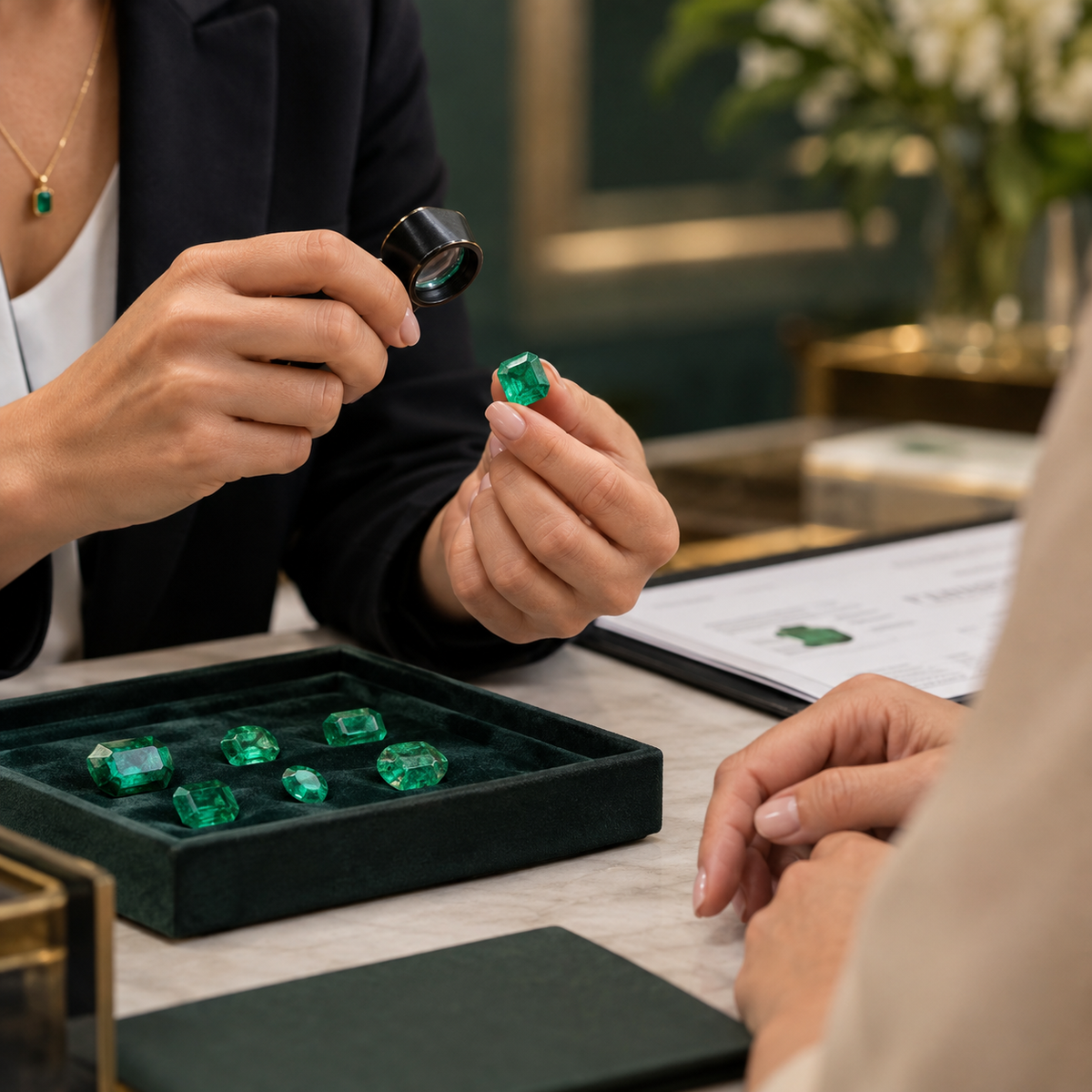
9. Can I see the emerald under a loupe?
Yes! If you are buying a valuable stone, examining it with a jeweler's loupe can be very interesting.
You can ask the seller to show you:
-
Inclusions.
-
Fractures.
-
Internal characteristics.
-
Color zones.
-
The stone's overall condition.
A seller who knows their product should be able to explain what you are seeing.
Emerald By Love: We Are Here to Help You With Your Emerald
Do not be afraid to ask questions. An informed purchase is not simply about finding a stone with an intense green color. It is about knowing what you are buying, where it comes from, how it has been treated, and what characteristics contribute to its value.
And if you are comparing several emeralds, take your time. Seeing them side by side and understanding their differences can help you find a stone that truly fits what you are looking for and your budget.
Paula Bonilla
Social Communicator and Journalist, Universidad Sergio Arboleda, Colombia