The Fingerprint of a Colombian Emerald: What Makes It Unique?
Every Colombian emerald has a story that begins long before it becomes a piece of jewelry. Its formation deep within the Earth, the characteristics of its inclusions, and the tiny details found in its structure give each stone its own identity.
But did you know that an emerald can have a kind of fingerprint? Although it is not a fingerprint like a person's, there are internal and external characteristics that help distinguish one gemstone from another and provide valuable information about its origin and individual features.
In this article, we explain what an emerald's fingerprint is, which elements make it unique, and how specialists use these characteristics to study natural emeralds.
What Is an Emerald's Fingerprint?
An emerald's fingerprint is a way of referring to the combination of distinctive characteristics that help differentiate one stone from another. These may include natural inclusions, tiny fractures, internal structures, growth patterns, and other features that develop during the gemstone's geological formation.
In gemology, these details are particularly important because they help specialists understand how an emerald formed and provide useful information for its identification.
Each gemstone develops under specific conditions of pressure, temperature, and chemical composition. For this reason, even two emeralds extracted from the same mine can display visible differences in their internal structures.
It is important to clarify that the term fingerprint does not necessarily refer to a single, unique characteristic or serve as independent proof of authenticity. Identifying an emerald requires examining several properties using appropriate gemological methods.
What Makes a Colombian Emerald Unique?
Several elements can help distinguish one natural emerald from another. Here are some of the most interesting ones.
1. Natural Inclusions, or Gardens
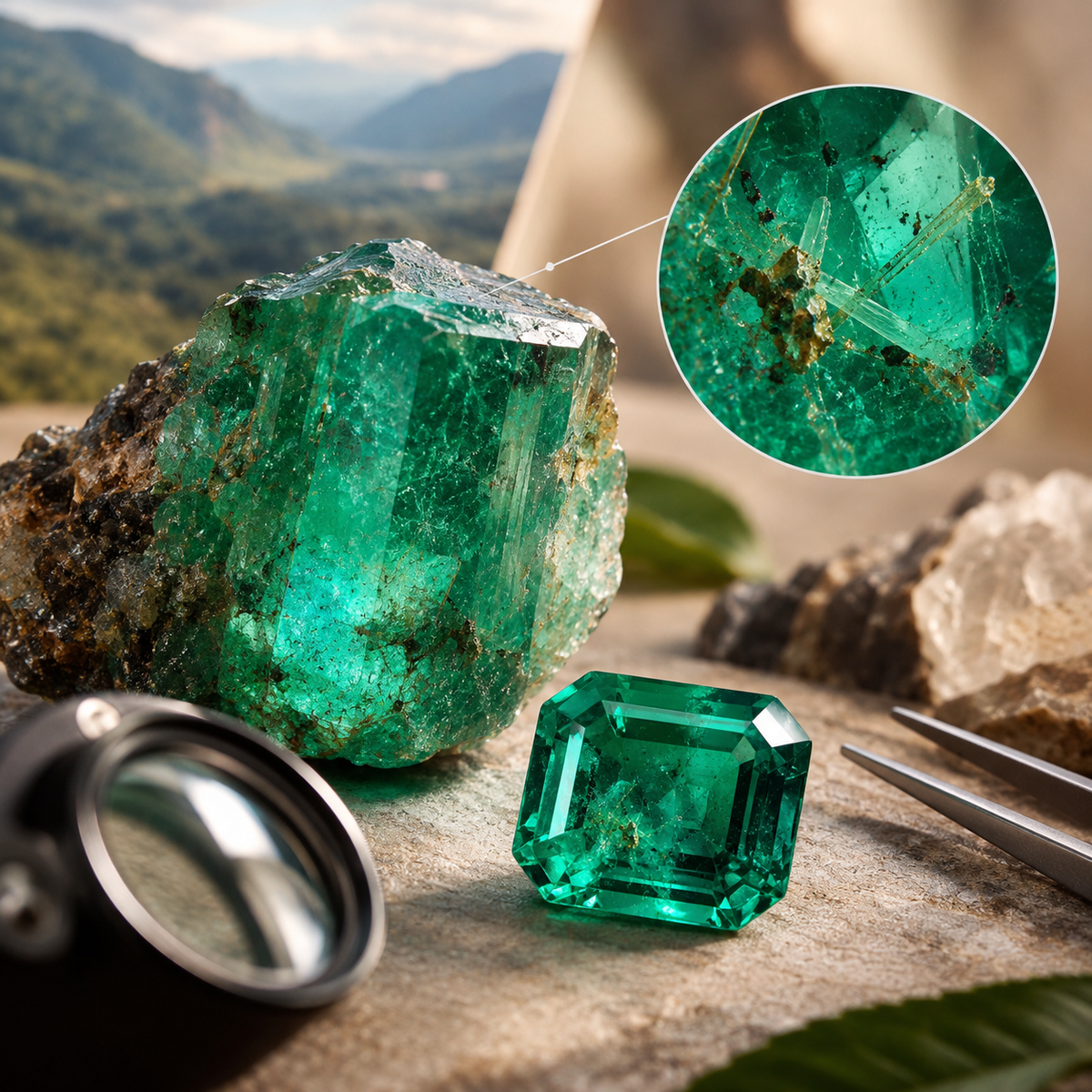
One of the best-known characteristics of emeralds is their inclusions, commonly called gardens because of the shapes and patterns they can create inside the stone.
These inclusions may consist of tiny mineral crystals, liquids, gases, or combinations of different materials. Small cavities and internal fractures may also be present.
Their distribution, shape, and nature can provide information about the gemstone's formation process.
In Colombian emeralds, these gardens are of particular interest because they can display combinations of internal features associated with the geological conditions of their deposits.
However, not all inclusions are alike, and not all emeralds contain the same amount. Some have highly visible gardens, while others display inclusions that are much less noticeable.
2. Tiny Fractures and Internal Structures
Emeralds may contain small fractures, fissures, and other natural irregularities that originated during their formation or throughout their geological history.
These details can influence the stone's appearance, transparency, and the way light travels through the crystal.
When examining an emerald with gemological tools, a specialist can study the shape and distribution of these structures to better understand the stone's characteristics.
It is also important to distinguish natural inclusions from damage that may occur after extraction, for example, during cutting, setting, or everyday wear.
3. Mineral Crystals Trapped Inside
Sometimes, an emerald contains tiny crystals of other minerals that became trapped as the gemstone grew.
Their shape, composition, and relationship with other inclusions can offer clues about the geological environment in which the gemstone developed.
In Colombian deposits, emeralds can be associated with minerals such as calcite, quartz, and pyrite, although mineral associations vary depending on the conditions of each deposit.
These details are particularly interesting to gemologists because they make it possible to study the stone's history beyond its external appearance.
4. Crystal Growth Patterns
Natural emeralds grow through geological processes that can take place over very long periods.
As the crystal forms, environmental conditions may change, leaving traces in its internal structure. These variations can appear as growth patterns or microscopic features that help specialists study the gemstone.
The combination of these patterns with inclusions and other properties can contribute to gemological identification.
Even when two stones have a similar green color and a comparable cut, their internal structures may be very different.
5. Color and Transparency
Color is one of the most recognizable characteristics of Colombian emeralds. Their shades can range from light greens to intense, deep greens, sometimes with slightly bluish undertones.
Transparency also varies from one stone to another. Some emeralds allow light to pass through the crystal more easily, while others contain gardens, clouds, or tiny fractures that alter their appearance.
Color and transparency do not constitute a fingerprint on their own, but they are part of the group of properties that specialists evaluate.
In addition, lighting, cut, stone orientation, and treatments can influence how an emerald looks to the eye.
Can an Emerald's Fingerprint Reveal Whether It Is Colombian?
This is one of the most important questions when it comes to identifying an emerald's origin.
Inclusions and other internal characteristics can provide clues about a gemstone's geographical origin. However, no single inclusion or visual feature can definitively confirm that an emerald comes from Colombia.
To determine geographical origin, gemological laboratories may combine microscopic examination with chemical composition analysis and other specialized tests. The conclusion depends on the available information and on how effectively the methods used can distinguish between possible origins.
For this reason, if you want to purchase a Colombian emerald, it is advisable to choose a trustworthy seller and request documentation supporting the stone's stated characteristics. When geographical origin is particularly important, a gemological report from a qualified laboratory can provide additional information.
Every Emerald Has a Story to Tell
The next time you look at a Colombian emerald, remember that its beauty depends on more than its green color. Inside, it may preserve tiny traces of the geological process that gave rise to it, from mineral crystals and gardens to distinctive growth patterns.
These details give each stone its own characteristics and make studying emeralds such a fascinating part of gemology.
At Emerald By Love, we believe that understanding an emerald is just as important as appreciating its beauty. That is why we work with natural Colombian emeralds and provide guidance to help our customers better understand each gemstone's characteristics before choosing a piece of jewelry.
If you are looking for a Colombian emerald for a special piece of jewelry or would like to learn more about its inclusions, origin, and characteristics, our team can help you find an option that suits your preferences.
Paula Bonilla
Social Communicator and Journalist, Sergio Arboleda University, Colombia.