Colombian Emeralds with Historical Significance
Throughout history, some emeralds have traveled from mines into the hands of emperors, sultans, royal families, and collectors. Others have become part of crowns, necklaces, and rings that are now preserved in museums and historical collections.
Among them are jewels featuring hundreds of emeralds, Colombian gemstones weighing more than 100 carats, and pieces that have survived changes in power, journeys across continents, and centuries of history.
What makes many of these gems especially interesting is something they share: Colombian emeralds. Their presence in historical jewelry shows just how far gemstones mined in Colombia have traveled and how they earned a place in some of the world's most important collections.
10 Colombian Emeralds with Historical Significance
1. The Crown of the Andes
The Crown of the Andes is one of the most famous examples of colonial goldsmithing in Latin America. It was crafted in Popayán, Colombia. Its circlet dates to approximately 1660, while its arches were added around 1770.
According to the records of the Metropolitan Museum of Art in New York, which acquired the crown in 2015, it is adorned with 443 emeralds.
One of its most notable gemstones is a 24-carat emerald known as the Atahualpa Emerald. Its association with the last Inca emperor is part of the crown's traditional history, although this attribution has not been conclusively proven.
The crown was created to adorn an image of the Virgin of the Immaculate Conception venerated in Popayán. Today, it stands as an important example of colonial jewelry and Colombia's historical emerald heritage.
2. The Maharaja of Indore's Emerald Necklace
This jewel, formerly known as the Spanish Inquisition Necklace, is connected to India's tradition of high jewelry.
The necklace features Colombian emeralds cut in the 17th century, some in elongated shapes and others with cuts designed to emphasize their green color. The gemstones are combined with Indian diamonds from Golconda.
One of its most interesting features is the blend of traditions: the emeralds were mined in Colombia, cut in India, and eventually incorporated into a jewel associated with the history of the maharajas.
The piece is preserved in the collection of the Smithsonian's National Museum of Natural History in the United States. It illustrates how Colombian gemstones reached Asian courts and became part of jewelry styles that differed considerably from those found in Europe.
3. The Mackay Emerald Necklace
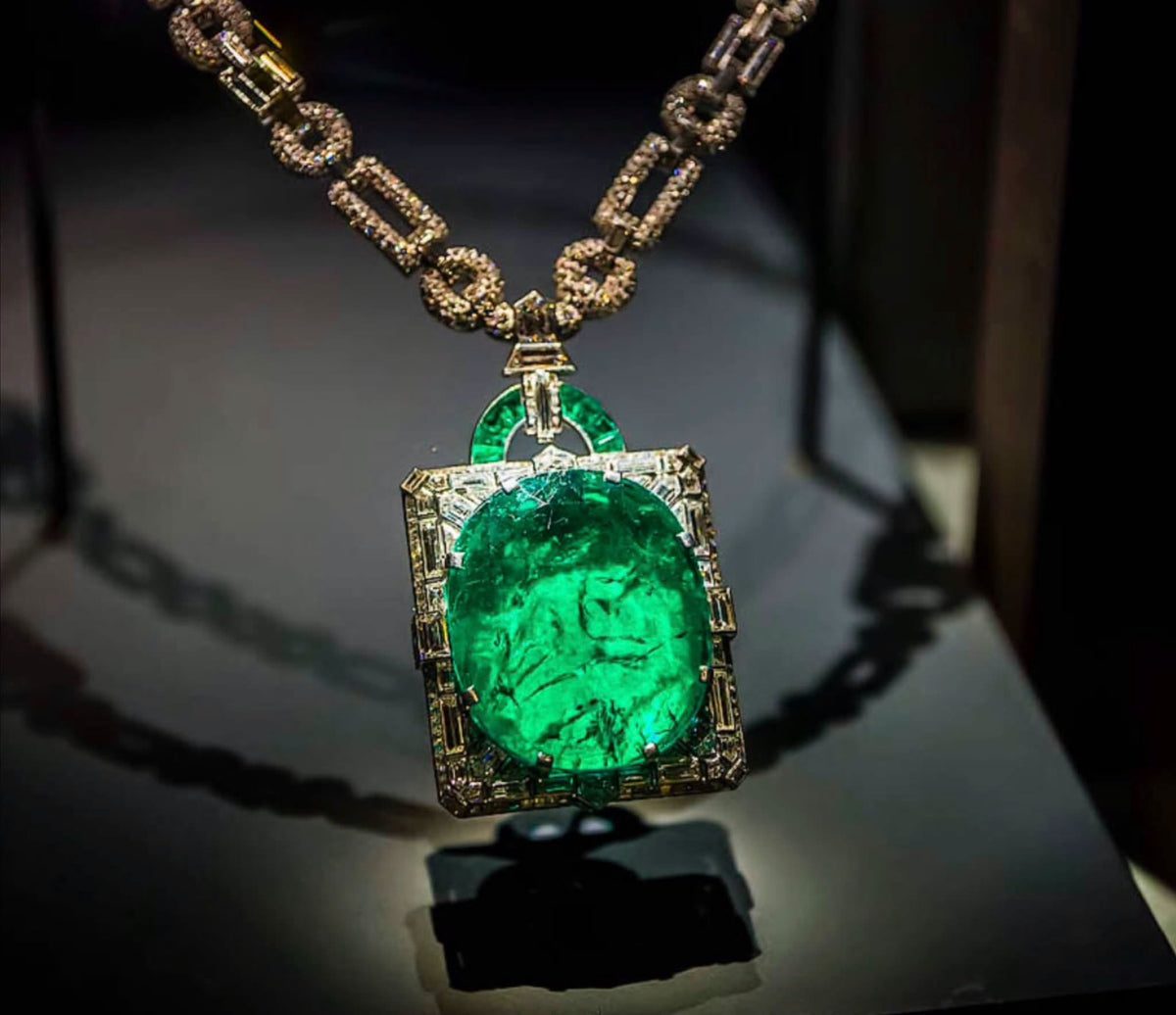
The Mackay Necklace is one of the best-known jewels in the United States' National Gem Collection.
Its centerpiece is a 167.97-carat Colombian emerald mined in Muzo and set in a platinum and diamond pendant designed by Cartier.
In 1931, Clarence Mackay gave the necklace to his wife, Anna Case, an opera singer at New York's Metropolitan Opera, as a wedding gift. The design includes 35 additional emeralds and 2,191 colorless diamonds.
The combination of a large central emerald and the brilliance of diamonds makes this necklace a remarkable example of Art Deco jewelry.
In 1984, Anna Case Mackay bequeathed the jewel to the Smithsonian, where it is now part of the National Museum of Natural History's collection.
4. The Hooker Emerald Brooch: The Colombian Emerald of a Sultan
The Hooker Emerald Brooch features a 75.47-carat Colombian emerald.
The gemstone once belonged to Ottoman Sultan Abdul Hamid II, who ruled from 1876 to 1909. According to a traditional account, the sultan wore it in his belt buckle.
In 1911, Tiffany & Co. purchased the emerald at auction. It was first set in a tiara and later transformed into the brooch we know today.
The gemstone is surrounded by diamonds set in platinum. In 1977, Janet Annenberg Hooker donated the piece to the Smithsonian, where it remains part of the National Gem Collection.
Its story shows how the same emerald can pass through different owners and designs while retaining its identity as the centerpiece of a jewel.
5. The Maximilian Emerald Ring
The Maximilian Emerald is a 21.04-carat Colombian gemstone that was once set in a ring belonging to Maximilian of Habsburg, who served as emperor of Mexico during the 19th century.
Maximilian arrived in Mexico in 1864 and was executed in 1867 following the fall of his government. The emerald survived that period and eventually became part of the collection of American collector Marjorie Merriweather Post.
In 1949, Cartier reset the gemstone in a platinum ring accented with diamonds.
In 1964, the jewel was donated to the Smithsonian. Today, it offers a glimpse into both the characteristics of a Colombian emerald and the history of a gemstone connected to one of the most well-known episodes in Mexican history.
6. The Chalk Emerald Ring
The Chalk Emerald is a 37.80-carat Colombian gemstone known for its intense green color and striking appearance.
According to the Smithsonian, the stone is believed to have been the centerpiece of an emerald and diamond necklace belonging to a maharani of the former Indian state of Baroda. This origin story is considered traditional rather than fully documented.
Later, Harry Winston incorporated the emerald into a ring made of platinum and gold, surrounded by 60 pear-shaped diamonds totaling approximately 15 carats.
The Chalk family donated the jewel to the Smithsonian in 1972.
This piece shows that a jewel's value depends on much more than the weight of its emerald. The gemstone's color and quality, the design, and the story behind it all contribute to its significance.
7. The Post Emerald Necklace
The Post Necklace was designed by Cartier between 1928 and 1929. Its Art Deco design combines influences from Indian jewelry with Colombian emeralds.
The piece features 24 emeralds cut into baroque drop shapes, each accompanied by a small emerald bead. The green gemstones are set in platinum and connected by diamond-decorated elements.
The necklace belonged to Marjorie Merriweather Post, a renowned American collector and philanthropist. In 1964, it became part of the Smithsonian's collection.
What makes this necklace special is that it does not rely on a single large central emerald. Instead, it uses numerous gemstones to create a continuous design in which green is the dominant color.
8. The Mughal Emerald Necklace
The Smithsonian's Mughal emerald necklace stands out for its Colombian emerald, carved into a flat plaque and decorated with floral motifs associated with India's Mughal art.
Unlike gemstones cut with facets to reflect light, this emerald was carved to display a design engraved on its surface.
It is currently set in a diamond-bordered pendant suspended from a double-strand diamond necklace. The piece in its present form was assembled in France around the turn of the 20th century.
Its history reflects the commercial and artistic connections between Colombia, India, and Europe. It also illustrates a different way of working with emeralds: transforming them into decorated surfaces that combine the gemstone's value with the art of engraving.
9. The Emerald Necklace from the Kingdom of Mysore
Among India's historical jewels is a horn-shaped pendant from the Kingdom of Mysore, crafted during the 18th century.
The piece features a 125-carat Colombian emerald accompanied by rubies, diamonds, and pearls in a 22-karat gold setting.
One of its most striking details is an Arabic inscription containing a greeting of peace. This makes the jewel more than a combination of precious gemstones: it is also an object that preserves a written expression and an artistic tradition from its time.
The pendant is among the examples documented by the Gemological Institute of America illustrating the connection between Colombian emeralds and India's historical jewelry.
10. The Great Mughal Emerald Necklace: A Piece of Imperial Tradition
Emeralds held an important place in Mughal courts, where precious gemstones were used in necklaces, rings, bracelets, and ceremonial ornaments.
Among the jewels associated with this tradition is a necklace featuring large carved emeralds linked to the imperial jewelry of South Asia. One historical version includes five Colombian emeralds totaling approximately 1,150 carats, including a central stone weighing around 470 carats.
The central gemstone bears an inscription associated with Ahmad Shah Durr-i Durran, founder of the Durrani Empire. The history of these jewels shows how Colombian emeralds traveled thousands of miles and were worked by artisans who developed their own cutting and decorative styles.
It is important to distinguish between different Mughal pieces and collections. Historical necklaces may have different names and origins, and not all traditional attributions are equally well documented.
What Do These Historical Jewels Have in Common?
Although each piece has a different story, they all show that an emerald's significance can go far beyond its size or color.
-
Origin: Several of these jewels feature emeralds mined in Colombia, particularly in mining regions such as Muzo and Chivor.
-
Craftsmanship: The design, cutting, setting, and combination of gold, platinum, and diamonds all contribute to each piece's identity.
-
Documented history: Former owners, museum donations, and collection records make it possible to trace parts of their journeys.
-
Cultural value: These jewels preserve information about the customs, power, and artistic expressions of different societies.
Not all of these pieces have a current market price, and assigning them an exact monetary value without an appraisal would be inappropriate. Their significance also lies in their uniqueness as historical objects, some of which are preserved in museums so future generations can learn about them.
Colombian Emeralds: Gemstones That Are Part of World History
From the Crown of the Andes to necklaces created by Cartier, Colombian emeralds have traveled across continents and become part of some of the most recognized jewels in history.
Each preserves a unique combination of origin, natural characteristics, design, and history. Some stand out for a central gemstone weighing hundreds of carats; others for hundreds of smaller stones assembled into a crown or for the craftsmanship that transforms an emerald into a one-of-a-kind jewel.
At Emerald By Love, this connection to history reminds us that behind every natural Colombian emerald is a gemstone formed deep within the Earth and a tradition that continues to thrive in jewelry today.
Paula Bonilla
Social Communicator and Journalist, Universidad Sergio Arboleda, Colombia