How Are Emeralds Mined in Colombia?
Many questions arise when we talk about Colombian emeralds, including how these famous gemstones are found and extracted. From open-pit mining, known in Colombia as paleo, to the traditional practice of huaqueo, emerald extraction in Colombia is a fascinating subject to explore.
In this article, we explain how emeralds are extracted in Colombia, the main mining techniques used, what paleo means, what huaqueo is, and what happens to an emerald from the moment it leaves the mine until it becomes a piece of jewelry.
Where Are Colombian Emeralds Found?
Colombian emeralds are found mainly in the departments of Boyacá and Cundinamarca, within two major emerald belts of the Eastern Cordillera of the Andes: the Western Emerald Belt and the Eastern Emerald Belt.
The Western Emerald Belt includes mining areas such as Muzo, Coscuez, Peñas Blancas, La Palma-Yacopí, and La Pita. The Eastern Emerald Belt includes Chivor, Gachalá, and Macanal.
One of the distinctive characteristics of Colombian emeralds is their sedimentary-hydrothermal origin. The gemstones are associated with hydrothermal veins and breccias within specific rock formations. In Muzo, for example, emeralds are associated with black shales, carbonate veins, and brecciated zones.
This means that miners do not simply "find green stones" inside a mountain. They must identify the geological structures where there is a greater possibility of finding emerald mineralization.
What Techniques Are Used to Extract Colombian Emeralds?
What Is "Paleo" in Emerald Mining?
The term paleo has been used in Colombia to refer to forms of open-pit mining, particularly in areas where surface material was removed in search of emeralds.
Today, Colombian emeralds are extracted primarily through underground mining, while open-pit mining largely belongs to earlier stages of exploitation in certain areas.
What Is Emerald Huaqueo?
Huaqueo is a traditional and artisanal method of searching for emeralds that has a long history in Colombia's emerald-producing regions.
The term is associated with the manual search for stones or materials that may contain gemstones, taking advantage of areas where mining activity or natural movements of the terrain have exposed mineralized material.
Historically, artisanal emerald mining in Colombia dates back to periods before the arrival of the Spanish. The Colombian Geological Service indicates that Indigenous peoples were already exploiting these mines using artisanal methods before colonial exploitation began.
How Are Emeralds Extracted in Colombia?
Emerald mining has changed considerably throughout history.
Today, underground mining is the main method of extraction in Colombia's emerald districts. However, to understand the history of this industry, it is also important to know about traditional and older methods such as huaqueo and other forms of artisanal mining.
The process can be summarized in several stages:
Exploration → identification of mineralized areas → construction of tunnels → rock extraction → searching for veins → separation of the rock → recovery of rough emeralds.
Let's take a closer look at each stage.
1. Exploration: First, You Have to Find the Emerald
Before mining begins, it is necessary to understand the terrain. Geologists study the characteristics of the rocks, tectonic structures, faults, veins, and hydrothermal alterations that may indicate the presence of mineralization.
In some modern mining projects, geological studies and exploration through tunnels and underground galleries are carried out to identify potentially productive areas.
Finding the right location is essential because not every rock within an emerald-producing area contains emeralds.
2. Underground Mining
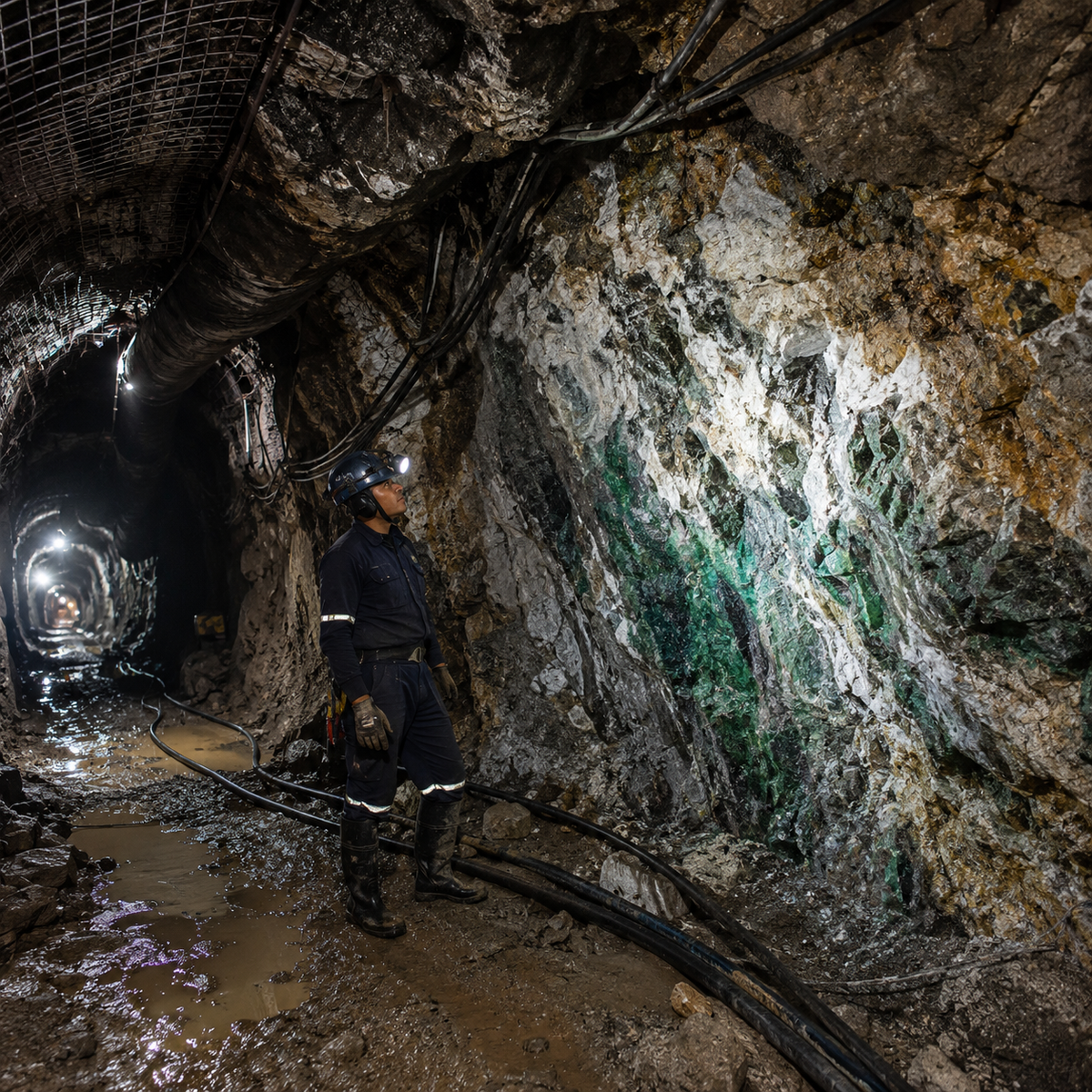
Today, a large part of commercial emerald extraction is carried out through underground tunnels and galleries.
Instead of removing the entire surface of a mountain, miners enter underground and follow the geological structures where emerald mineralization may occur.
In Muzo, for example, there are several underground galleries that reach significant depths. The Puerto Arturo operation includes vertical galleries and a spiral ramp connecting different levels of the mine.
3. What Do Miners Do Inside the Tunnels?
Once inside the mine, workers search for geological structures that may contain emeralds.
Some mining operations use pneumatic tools, drilling equipment, and specialized machinery to advance through the rock. Depending on the operation, controlled rock-fragmentation techniques may also be used.
In Muzo, for example, miners work through dark shales while searching for characteristic calcite veins that can indicate the possible presence of emeralds nearby. They then have to carefully separate the crystal from the surrounding rock.
The search is complex because finding a mineralized vein does not guarantee that it contains a high-quality emerald.
4. Separating the Emerald from the Rock
Once an area with potential is identified, one of the most delicate stages of the process begins: extracting the emerald without damaging it.
Emeralds can be associated with minerals such as calcite, dolomite, pyrite, and other materials found within hydrothermal veins and breccias.
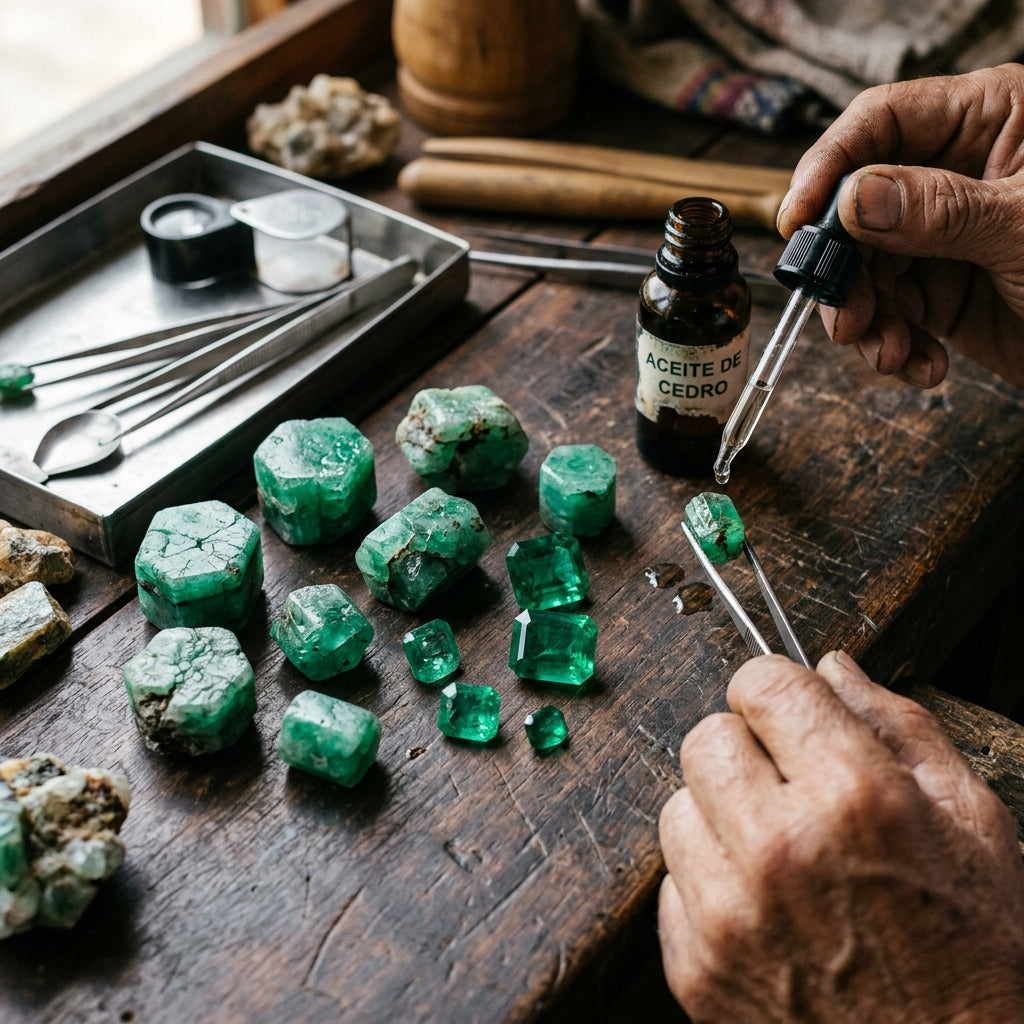
As a result, a rough emerald may come out of the mine partially covered by rock and other minerals.
The material surrounding the crystal must be carefully removed to determine:
- Whether it is actually an emerald
- Its size
- Its transparency
- Its color
- The inclusions it contains
- Whether it can be cut
- Its commercial potential
This is one of the reasons why a rough emerald cannot be valued based solely on its weight.
Why Is It So Difficult to Find a High-Quality Emerald?
Because finding mineralization does not necessarily mean finding an exceptional gemstone.
A mine can produce large quantities of material, and within that material there may be numerous rough emeralds of different sizes and qualities.
Only a portion will have the characteristics required to become a high-quality gemstone. Color, transparency, inclusions, size, crystal quality, and the potential for achieving a good cut all influence an emerald's value.
In addition, natural inclusions are a common characteristic of emeralds. They can help distinguish them from other gemstones and provide information about their origin.
The Colombian National Mining Agency highlights that Colombian emeralds have characteristic inclusions that form part of their gemological identity.
Emerald By Love: Visit an Emerald Mine in Colombia
Yes, there are experiences related to Colombian emerald culture and the world of emerald mining, particularly in producing regions such as Boyacá.
An emerald tour can allow you to learn more about the history of mining, visit places connected to emerald production, and understand how the process develops from extraction to commercialization.
However, access to an active mine should not be taken for granted. Mines are industrial environments that may have safety restrictions, permits, and specific access requirements.
Therefore, if you want to experience a mining operation up close, it is recommended to do so through an authorized and organized tour while following all applicable safety instructions.
Paula A. Bonilla
Social Communicator and Journalist from Universidad Sergio Arboleda in Colombia.