The Rarest Inclusions Found in Colombian Emeralds
When talking about Colombian emeralds, it is impossible not to mention their natural inclusions, also known as "gardens." Far from being flaws, many inclusions give each emerald its unique identity and, in some cases, can even increase its appeal to collectors and gemologists.
While most emeralds contain common inclusions such as tiny fractures, fluids, or trapped minerals, some inclusions are extremely rare and can even help confirm that an emerald originated in Colombia.
What Is an Inclusion in a Colombian Emerald?
An inclusion is a natural feature that formed inside the emerald during its growth process millions of years ago. These may consist of tiny crystals of other minerals, minute fractures, cavities containing liquids or gases, or various structures created by the geological conditions under which the gemstone formed.
In Colombian emeralds, inclusions are completely natural and are considered part of the gem's identity. In fact, many people refer to them as the emerald's "garden," because when viewed under magnification they often resemble miniature natural landscapes.
Unlike many other gemstones, where buyers typically seek stones with as few inclusions as possible, emerald inclusions help confirm the gem's natural origin and, when examined by experts, provide valuable information about its formation and authenticity.
Common Inclusions in Colombian Emeralds
The most common inclusions found in Colombian emeralds include:
- Natural fractures: Small internal fissures formed during the gemstone's growth.
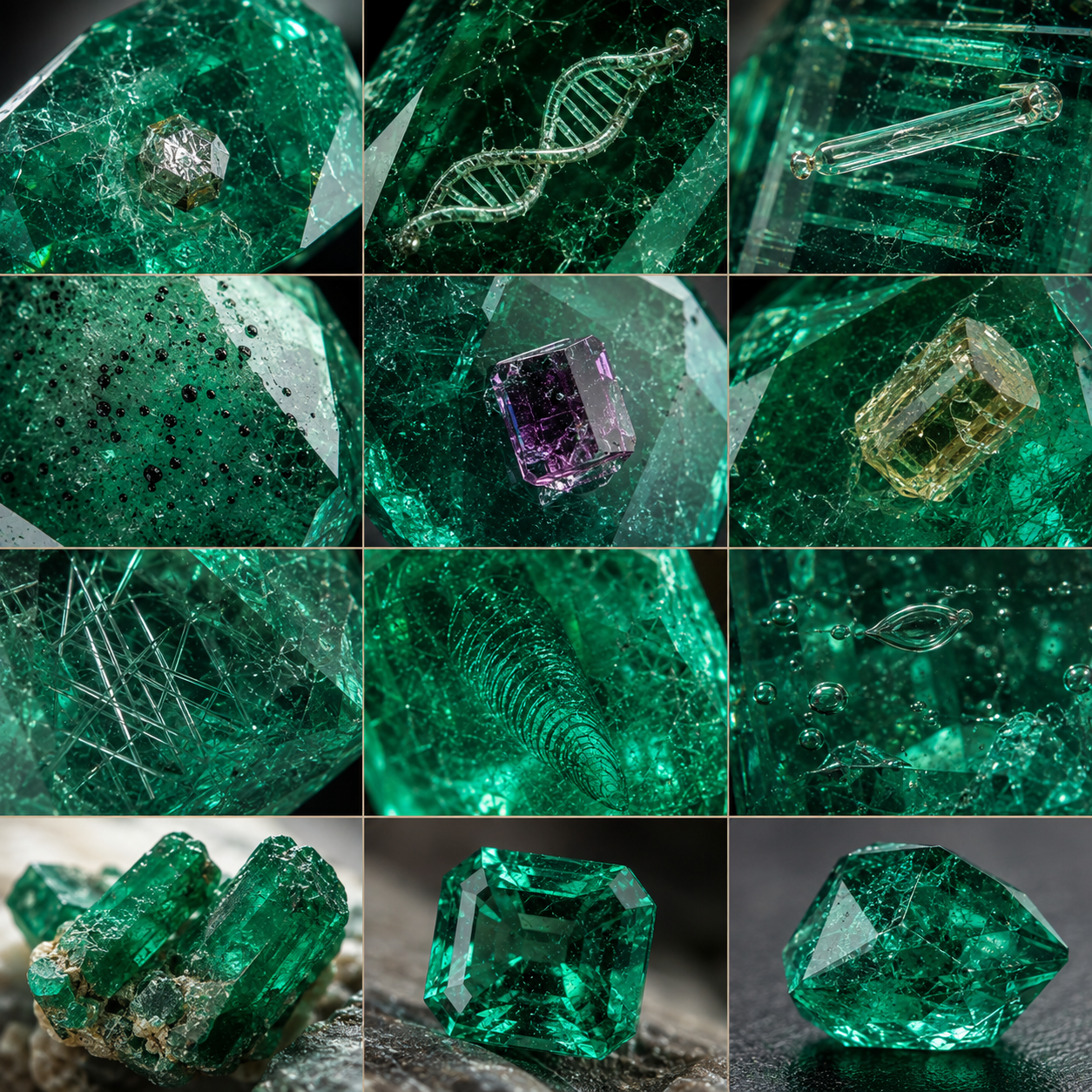
- Three-phase inclusions: These contain a liquid, a gas bubble, and a tiny crystal. They are among the most characteristic features of Colombian emeralds.
- Pyrite crystals: Small metallic golden crystals trapped inside the emerald.
- Calcite: A white mineral that may occur in small amounts.
- Albite: A white feldspar commonly found in many Colombian emeralds.
- Natural fluid inclusions: Cavities filled with mineral-rich solutions trapped during crystal growth.
- Growth tubes and channels: Tiny structures that reveal how the emerald developed inside the host rock.
The Rarest Inclusions Found in Colombian Emeralds
Although most inclusions are relatively common, some are exceptionally rare and highly valued by gemologists and collectors.
1. Parisite Crystals
Parisite is a rare mineral composed of rare-earth elements. Finding it as an inclusion inside a Colombian emerald is uncommon and of significant scientific interest.
2. Emerald Crystals Trapped Inside Another Emerald
During crystal growth, small emerald crystals may become encapsulated within a larger emerald crystal, creating an exceptionally unusual natural phenomenon.
3. Fluorite Crystals
Although fluorite itself is a well-known mineral, its occurrence as an inclusion in Colombian emeralds is relatively rare.
4. Complex Multi-Phase Inclusions
Some cavities contain more than three phases, including liquids, gases, and multiple crystals, making them true microscopic geological laboratories.
5. Perfectly Formed Mineral Crystals
In exceptional cases, tiny, fully developed crystals of other minerals can be found inside an emerald, preserving their original crystal shape.
6. Geometrically Oriented Inclusions
Some inclusions are aligned with the emerald's crystal structure, creating geometric patterns that attract the attention of specialists.
7. Unique Mineral Combinations
Certain emeralds contain several rare minerals within a single inclusion, a highly unusual occurrence that is especially valuable for gemological research.
Why Are These Inclusions Important?
For a gemologist, inclusions serve as a gemstone's fingerprint. They help distinguish natural emeralds from synthetic ones, identify treatments, and, in many cases, determine the gemstone's geographic origin. Every inclusion also tells part of the emerald's geological story, ensuring that no two emeralds are ever exactly alike.
Do Inclusions Reduce an Emerald's Value?
Not necessarily. Visible inclusions are completely normal in emeralds because they belong to the Type III clarity classification. In fact, a rare, attractive, or diagnostic inclusion may increase scientific interest and appeal among collectors. What truly matters is that the inclusion does not significantly affect the gemstone's transparency, durability, or overall beauty.
Discover Authentic Colombian Emeralds at Emerald By Love
At Emerald By Love, we work exclusively with certified natural Colombian emeralds carefully selected for their color, quality, and authenticity. Every gemstone possesses unique internal characteristics that reflect millions of years of natural formation, making each piece of jewelry truly one of a kind. If you would like to learn more about the fascinating world of Colombian emeralds or find a special piece, our team will be delighted to assist you.
Paula A. Bonilla
Social Communicator and Journalist from Sergio Arboleda University, Colombia.