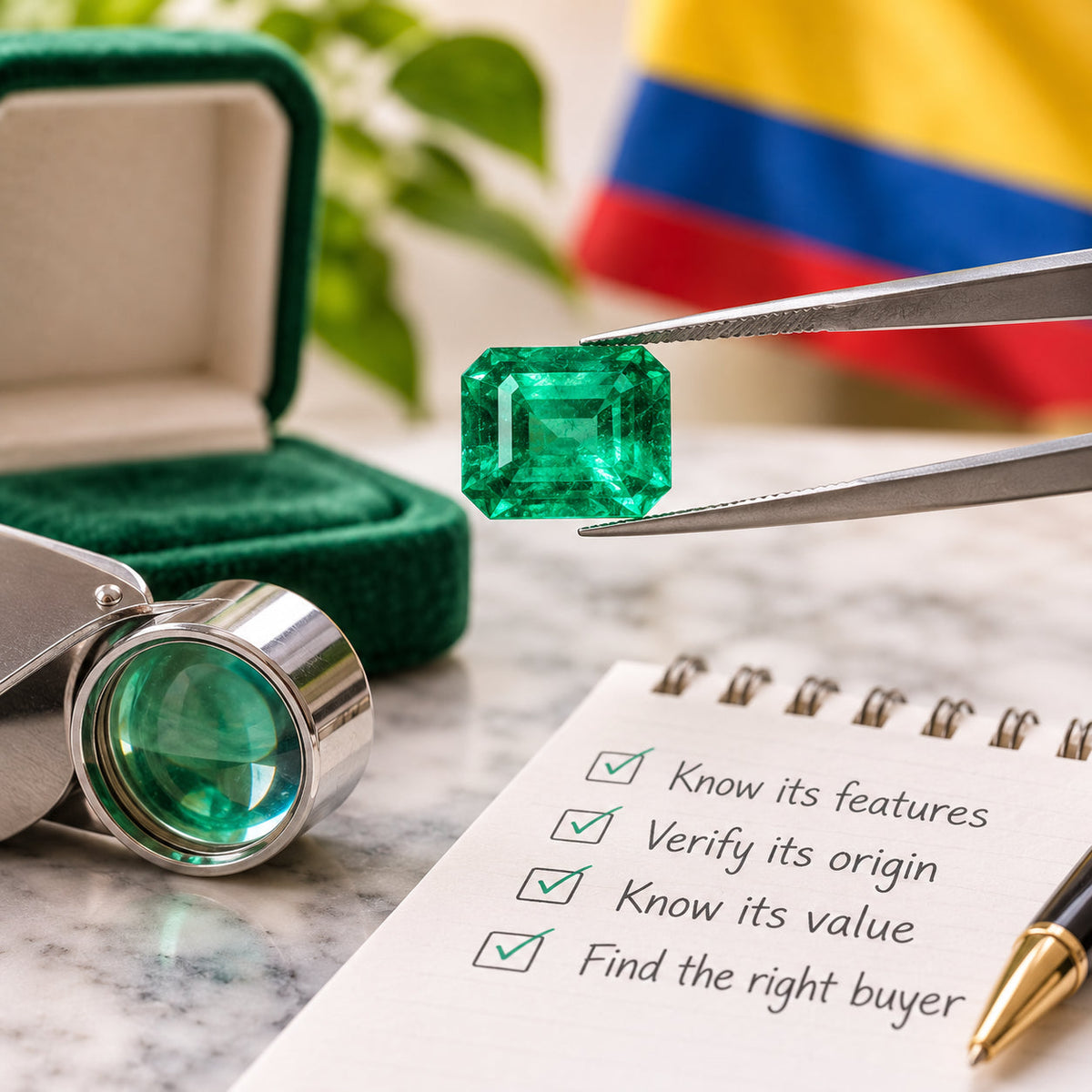
Article: Evolution of Colombian Emerald Prices
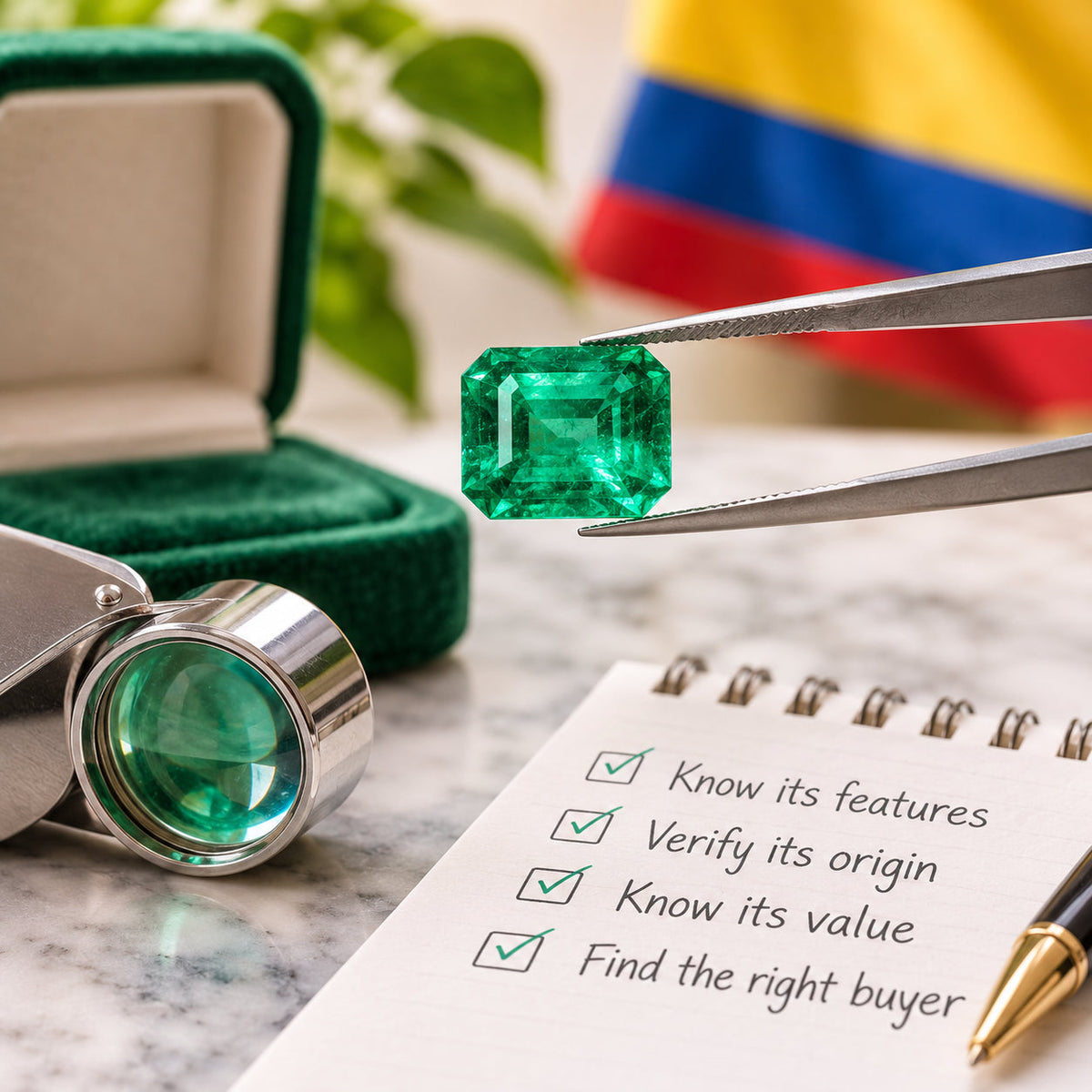
Evolution of Colombian Emerald Prices
In addition to their historical significance, Colombian emeralds have also experienced changes in their market prices over time.
But how much did a Colombian emerald cost a few decades ago? Why have some emeralds increased considerably in value? What factors influence their prices today, and what can we expect from the market in the coming years?
To understand the evolution of Colombian emerald prices, it is important to know how their market works and why not all stones appreciate in value in the same way.
How Did the Colombian Emerald Market Begin?
The commercial history of Colombian emeralds is closely connected to the mines of Boyacá and Cundinamarca, particularly regions such as Muzo, Coscuez, Chivor, and Gachalá.
For centuries, these gemstones have been valued for their color and rarity. However, it was during the 20th century that Colombia began establishing itself as one of the world's leading references for emerald production and trade.
One of the most significant periods was the so-called Emerald Boom, which took place between the late 1970s and early 1990s. During this time, mining and commercial activity increased considerably, and Colombian emeralds gained greater recognition in international markets.
As an indication of this growth, Colombian emerald exports increased from approximately USD 2 million in 1973 to USD 40 million in 1978, according to historical records cited in industry studies.
Colombian Emeralds Through the Decades
Price trends have not been the same across every period. Mining supply, international demand, economic conditions, and the availability of high-quality stones have all influenced their evolution.
1970s and 1980s: Growth and International Recognition
During these decades, the Colombian market experienced significant expansion. Mining activity and exports increased, while international buyers began paying greater attention to emeralds originating from Colombia.
Growing demand helped strengthen their commercial recognition. However, not all stones commanded the same prices. Color, transparency, size, and internal characteristics were already important factors in determining their value.
1990s: Market Changes and Price Fluctuations
In the early 1990s, the international market underwent significant changes.
During the first half of the decade, interest in emeralds increased, partly driven by buyers seeking alternatives within the gemstone market. However, the stabilization of other markets and changes in demand subsequently led to a decline in prices.
This demonstrates that although emeralds can maintain their appeal over the long term, they are not immune to international economic cycles.
Los Angeles Times
2000s: Greater Differentiation Between Quality Grades
During the 2000s, the market began to show increasingly significant differences between commercial-grade emeralds and higher-quality stones.
Gems with excellent color, transparency, size, and uncommon characteristics began to stand out, particularly among collectors and specialized buyers.
A study on Colombian emerald prices at international auctions identified considerable growth in the prices of higher-quality lots during the 2001–2010 period.
2010s: Growing Recognition of Exceptional Stones
During this decade, Colombian emeralds with exceptional characteristics achieved significant prices at international auctions.
An analysis of notable auction sales between 2001 and 2015 found an average annual growth of approximately 10% in the per-carat prices of the lots analyzed. For the five highest-quality lots each year, the estimated growth was approximately 15% annually.
It is important to clarify that these percentages refer to a selection of auction results and do not represent the price performance of all Colombian emeralds.
Piat - Partner of designers
2020–2026: Scarcity, Demand, and New Buyers
In recent years, the market has shown particular interest in high-quality emeralds, especially those with characteristics that are difficult to find.
For example, a market analysis published in 2022 reported that a 10-carat Colombian emerald could increase from a range of USD 20,000–25,000 per carat in 2020 to USD 35,000–40,000 per carat by the end of 2021.
This trend was associated with a limited supply of large, high-quality stones, combined with growing demand.
In 2024, the National Mining Agency (Agencia Nacional de Minería) published a technical report estimating that the price per carat of a cut Colombian emerald could range from USD 200 to USD 150,000, depending on its quality. This wide range demonstrates that there is no single fixed price for these gemstones.
How Much Does a Colombian Emerald Cost Today?
One of the most frequently asked questions among people interested in buying an emerald is how much they should expect to pay.
The answer depends on the stone's characteristics. Below, we present our quality classification guide to help you choose the perfect gemstone according to your style, budget, or investment goals.
1. Quality B: Elegant Commercial-Grade Emerald
Clarity: Opaque to translucent.
Estimated price: USD 70–350 per carat (+ taxes).
Description: These are commercial-grade gemstones with strong market demand. They are genuine Colombian emeralds available at highly affordable prices, with noticeable color. They are an excellent choice if you are looking for a gemstone to set in everyday jewelry.
2. Quality A: High Commercial Grade
Clarity: Translucent to transparent.
Estimated price: USD 500–1,000 per carat (+ taxes).
Description: These gemstones stand out for their remarkable internal life and brilliance. They offer excellent visual clarity, highlighting the stone's natural beauty. They are a favorite choice for those seeking the right balance between brilliance and transparency for a smart purchase.
3. Quality AA: Premium Quality and Fine Jewelry
Clarity: Translucent to transparent, with optimal saturation.
Estimated price: USD 1,200–2,800 per carat (+ taxes).
Description: Superior gemstones that offer a balance between a deep green hue and crystal-like clarity. With fewer inclusions (the famous emerald "jardin"), light travels through them beautifully. These are exceptional stones, highly sought after for fine jewelry designs and considered potential medium-term value-appreciation pieces.
4. Quality AAA: Investment Grade / Intense Color
Clarity: Transparent (high-purity, clean gemstones).
Estimated price: From USD 4,000 per carat (+ taxes).
Description: The finest of Colombian gemology. These emeralds display an intense, deep green color and crystal-like brilliance. They are extremely rare collector's stones, highly sought after in the world's most demanding markets, including Asia, Europe, and North America. This grade is favored by celebrities, collectors, and international investors because of its potential to retain and increase its value over time.
Note for buyers: Remember that every emerald is unique. Small internal imperfections are not defects; they are part of the emerald's natural "jardin," a characteristic associated with its natural origin and authenticity.
What Factors Have Driven Emerald Prices Up?
Although each period has had its own particular circumstances, several factors help explain why certain Colombian emeralds have increased in value.
1. Availability of High-Quality Stones
Emeralds form under specific geological conditions, and their extraction depends on the irregular distribution of mineral deposits. Finding a large stone with excellent color and transparency is never something that can be guaranteed in a mining operation.
2. International Demand
The United States, Hong Kong, Japan, and other international markets have maintained their interest in Colombian emeralds. According to the National Mining Agency, the United States and Hong Kong were the main destinations for Colombian cut emerald exports in 2023.
mineriaencolombia.anm.gov.co
3. Interest from Collectors
Exceptional stones have their own specialized market. Collectors often look for characteristics that are difficult to find, such as significant size, attractive color, good transparency, and minimal treatments.
4. Recognition of Geographic Origin
Geographic origin can influence an emerald's commercial appeal. Colombia has a longstanding reputation in the international market, and its mines are recognized for producing stones with distinctive gemological characteristics.
5. Industry Transformation
The modernization of mining operations, formalization, and traceability processes have also contributed to transforming the way these gemstones are marketed and traded.
Where Can You Buy Colombian Emeralds?
The emerald market includes various intermediaries, distributors, and traders. For this reason, knowing a stone's origin and having access to information about its extraction and commercialization can make an important difference.
At Emerald By Love, we work exclusively with natural Colombian emeralds, backed by a family tradition of more than 40 years in the industry.
Our philosophy is based on the concept of From the Mine to Your Hands, aiming to reduce intermediaries and maintain greater knowledge and control over the gemstones we offer.
We offer Colombian emeralds in different sizes, colors, cuts, and qualities, as well as custom-made jewelry crafted in 18-karat gold and natural diamonds.
If you are looking for an emerald for your collection, a special piece of jewelry, or a gemstone with specific characteristics, our team can guide you in finding an option that matches your expectations and budget.
The Value of an Emerald Goes Beyond Its Price
The evolution of Colombian emerald prices demonstrates the important role these precious gemstones have played in international markets for decades.
Their value is influenced by factors such as availability, demand, origin, and, most importantly, their gemological characteristics.
Although some exceptional emeralds have experienced significant price increases, the most important thing when making a purchase is learning how to recognize the quality of each stone.
Because, ultimately, a good purchase is not simply about acquiring the largest or most expensive emerald, but about finding a gemstone whose characteristics justify its value.
Paula Bonilla
Social Communicator and Journalist, Universidad Sergio Arboleda, Colombia