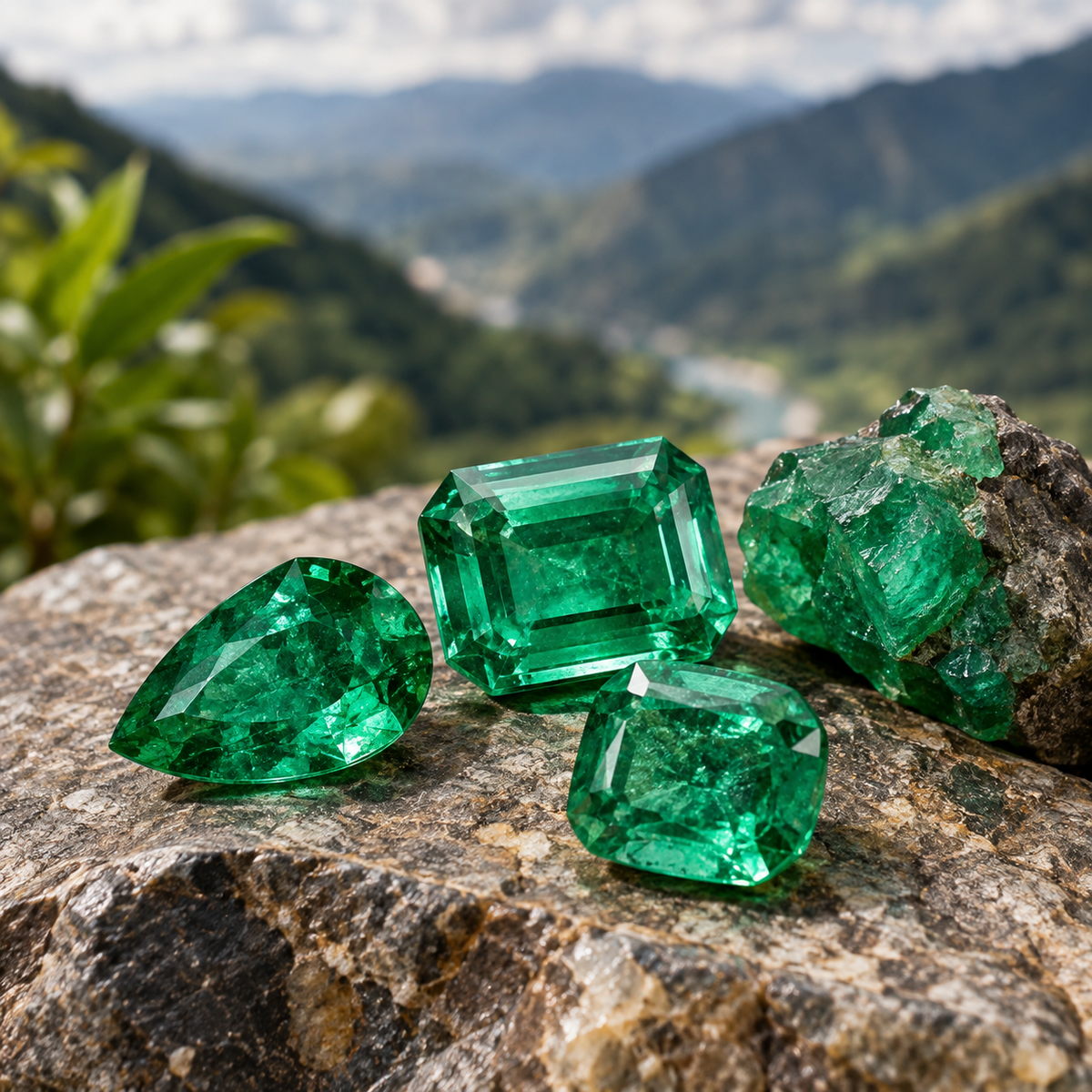
Colombian Emeralds That Found Their Way Into International Museums
Colombian emeralds have traveled far beyond the mountains where they were originally found. Some ended up in the hands of emperors, royal families, major collectors, and famous jewelry houses. But others had an even more special destination: becoming part of important international museum collections.
Today, Colombian emeralds can be found in institutions such as the Smithsonian National Museum of Natural History in Washington, D.C., and The Metropolitan Museum of Art in New York. They are preserved there not only for their beauty, but also for the history they represent.
An emerald can be much more than a gemstone. Its origin, size, color, formation, and journey through time can make it a piece of enormous historical and scientific importance.
Why Do Museums Preserve Colombian Emeralds?
When an emerald enters a museum collection, its importance does not necessarily depend only on its price.
Museums may be interested in a gemstone for many different reasons: its exceptional size, provenance, gemological characteristics, age, history, or the significance of the piece of jewelry in which it is set.
In the Colombian case, there is also a very particular element: emeralds from regions such as Muzo, Chivor, and Gachalá have a mining history that dates back to long before the arrival of the Spanish.
The Smithsonian, for example, preserves several of the world's best-known Colombian emeralds as part of its National Gem Collection.
Colombian Emeralds in Museums
- The Gachala Emerald: 858 Carats
One of the most impressive pieces is the Gachala Emerald, known in Spanish as the Esmeralda de Gachalá.
This extraordinary specimen weighs 858 carats and was found in 1967 at the Vega de San Juan mine in Gachalá, Cundinamarca. The famous jeweler Harry Winston donated it to the Smithsonian in 1969.
Its size is particularly remarkable because large emerald crystals with good characteristics are uncommon. The Smithsonian itself notes that crystals of this size would normally be cut to produce gemstones.
Today, the Gachala Emerald is part of the collection at the National Museum of Natural History in Washington, D.C. And yes, it is Colombian.
The Mackay Emerald: An Emerald from Muzo
Another Smithsonian highlight is the Mackay Emerald, which was mined in Muzo, Colombia.
The stone weighs 167.97 carats and is set in an impressive necklace designed by Cartier. The Smithsonian considers it the largest cut emerald in its National Gem Collection.
The history of this gemstone is also connected to high jewelry. The necklace was a wedding gift from Clarence Mackay to his wife, Anna Case, in 1931.
The piece is made of platinum and features diamonds and other emeralds surrounding the central stone. Anna Case Mackay left the necklace to the Smithsonian in 1984.
It is an excellent example of how a Colombian emerald can travel from a mine in Muzo to become part of an internationally renowned collection.
The Hooker Emerald and Its Connection to the Ottoman Empire
The Hooker Emerald weighs 75.47 carats and is also of Colombian origin.
Before reaching the Smithsonian, the stone had a fascinating international history. According to the museum, it belonged to Ottoman Sultan Abdul Hamid II and was later acquired by Tiffany & Co. at an auction in 1911.
Tiffany first incorporated the emerald into a tiara and later mounted it in a platinum brooch surrounded by numerous diamonds.
Janet Annenberg Hooker purchased the brooch in 1955 and eventually donated it to the Smithsonian in 1977. It is currently displayed in the museum's gem gallery.
A Colombian emerald that passed through the hands of a sultan, one of the world's most renowned jewelry houses, and an important collector before ultimately becoming part of a museum collection.
The Chalk Emerald
The Chalk Emerald is another major Colombian emerald in the Smithsonian's collection.
It weighs 37.80 carats and is known for its intense green color and clarity. The Smithsonian classifies it among the finest Colombian emeralds in its collection.
The history of this stone is also connected to India. According to the Smithsonian, there is a tradition that it was once part of a necklace belonging to a maharani of the former state of Baroda.
It was later recut and mounted in a ring designed by Harry Winston, surrounded by 60 pear-shaped diamonds. The piece was donated to the Smithsonian in 1972.
The Maximilian Emerald
Another Colombian emerald housed at the Smithsonian is the Maximilian Emerald, weighing 21.04 carats.
Its name is associated with Maximilian of Habsburg, who was Emperor of Mexico from 1864 to 1867. According to the Smithsonian, the emerald was mounted in a ring that he wore.
Later, the stone became part of the collection of Marjorie Merriweather Post. Cartier reset it in 1949, and in 1964, Post donated the ring to the Smithsonian.
The gemstone remains part of the museum's National Gem Collection.
The Crown of the Andes: Colombian Emeralds in a Single Masterpiece
When discussing historic pieces that bring together a large number of Colombian emeralds, it is impossible not to mention the Crown of the Andes.
Also known as the Crown of the Andes, the crown was created in Popayán, Colombia, and is currently part of the collection of The Metropolitan Museum of Art in New York.
The Met explains that the crown is decorated with more than 400 untreated South American emeralds. Among them is an approximately 24-carat emerald known as the Atahualpa Emerald.
The piece was created to adorn an image of the Virgin of the Immaculate Conception venerated in the cathedral of Popayán.
Its diadem dates to approximately 1660, while the arches date to around 1770.
After centuries of history, the Crown of the Andes eventually crossed the continent and can now be admired at The Met.
The Legacy of Colombian Emeralds
Today, visitors from around the world can admire these gemstones in international museums and learn a small part of the history of Colombian emeralds.
The Gachala Emerald, the Mackay Emerald, the Hooker Emerald, the Chalk Emerald, and the Maximilian Emerald, among others, represent different chapters of that history.
And the Crown of the Andes shows that even an entire historic piece can become a way of preserving the legacy of Colombian mining and jewelry.
From the mountains of Colombia to the display cases of the Smithsonian and The Met, these emeralds have traveled thousands of miles and through hundreds of years of history.
And perhaps that is one of the most fascinating things about a Colombian emerald: it is never simply a stone. It can also be part of a story that began centuries ago and continues to this day.
Colombian Emeralds at Emerald By Love
At Emerald By Love, we believe that understanding the origin and characteristics of an emerald is an essential part of learning how to choose one.
We work with natural Colombian emeralds available in different colors, sizes, cuts, qualities, and levels of treatment. If you are looking for an emerald for a piece of jewelry, a collection, or simply want to learn more about the available options, our team can guide you toward a stone that suits your preferences and budget.
Because every Colombian emerald has something to tell.
Paula Bonilla
Social Communicator and Journalist, Sergio Arboleda University, Colombia