What Does It Mean When a Colombian Emerald Has Oil?
One of the most common questions when talking about Colombian emeralds is: What does it mean when an emerald has oil? Is it something good or bad? Does an oiled emerald lose value? Do all emeralds contain oil?
The answer may surprise you: oiling an emerald is a very common treatment in the gemstone world and does not mean that the stone is of poor quality.
In this article, we explain in simple terms what oil means in emeralds, what types of treatments exist, what substances may be used, and how treatment can influence the price of a Colombian emerald.
What Is Oil in an Emerald?
When an emerald is described as oiled, it means that the stone has received a treatment in which a substance is introduced into some of its small fractures and surface-reaching cavities.
The main purpose is to visually disguise certain fractures, making them less noticeable and allowing the emerald to have a more uniform and transparent appearance.
This is especially important because natural emeralds commonly contain inclusions and fractures. In fact, finding an emerald that is completely free of inclusions is extremely rare.
For this reason, oil treatment has traditionally been used in the emerald trade, and emeralds can be found under the following treatment classifications:
F1 – Minor or Light Treatment
- A small amount of filling material was used, frequently oil.
- The effect on the appearance is subtle.
- Natural fissures may still be visible.
- This level of treatment is generally well accepted commercially.
F2 – Moderate Treatment
- A greater amount of filling material is present than in F1.
- The improvement in clarity is more noticeable.
- Surface-reaching fissures may become less visible.
- It generally has a lower price than an F1 emerald, considering that treatment is only one of the factors that determine value.
F3 – Significant Treatment
This means that the effect of the treatment on the emerald's appearance is evident.
Why Are Emeralds Oiled?
Emeralds can naturally contain small fractures. Some are very visible, while others are almost imperceptible.
By introducing oil or another substance into certain fractures, these characteristics can become less noticeable to the naked eye.
The result may be a gemstone that visually appears:
- Cleaner.
- More uniform.
- With less visible fractures.
- More transparent in appearance.
It is important to understand that treatment does not remove inclusions or fractures. It can simply reduce their visual appearance.
What Treatments Are Used in Emeralds?
Not all emeralds receive the same treatment. The methods and substances used can vary. Among the best-known treatments are oiling, the use of resins, and other materials used to fill fractures.
1. Oiling
Oiling is one of the best-known traditional emerald treatments.
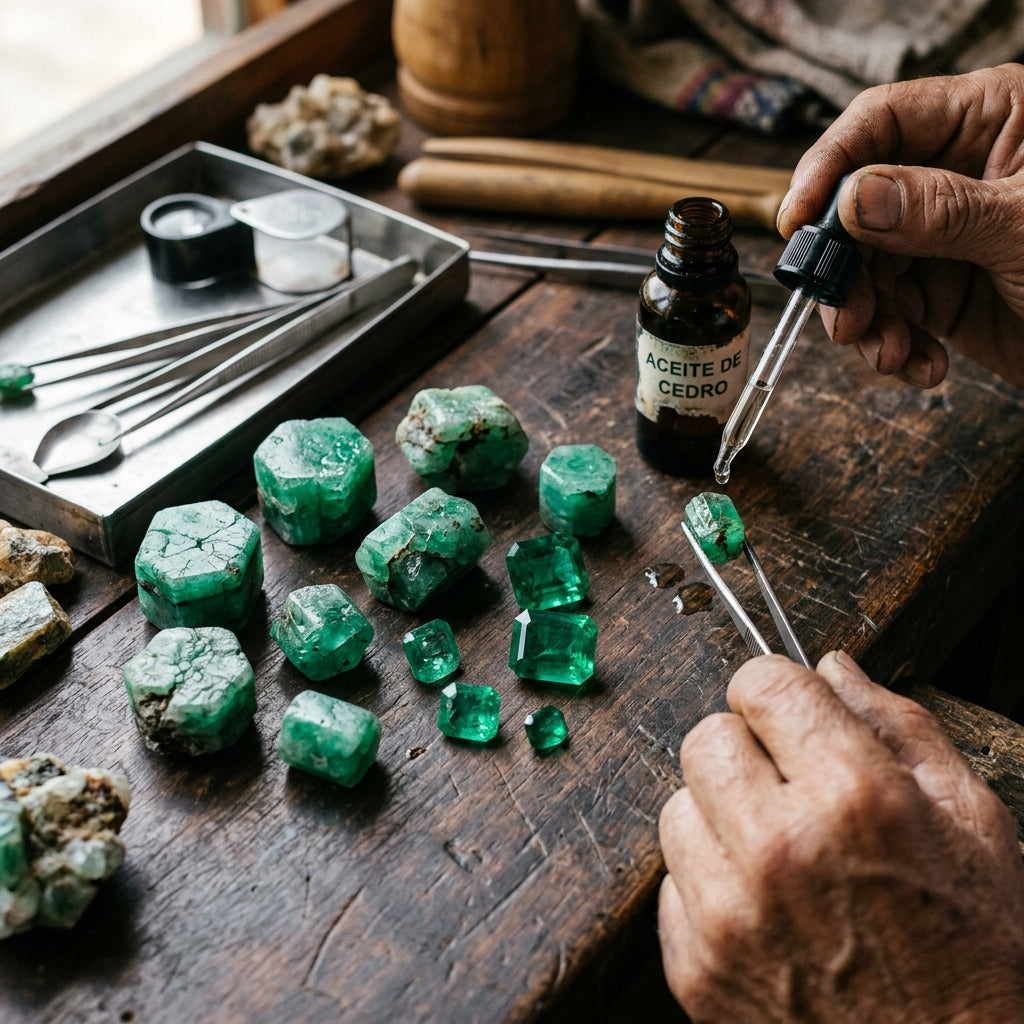
It consists of introducing a liquid, generally an oil, into some of the emerald's fractures. The purpose is to reduce the visibility of these characteristics and improve the gemstone's appearance.
Oiling is a widely known and accepted treatment in the emerald trade, as long as it is properly disclosed.
2. Resin Filling
Instead of oil, some emeralds may be treated with higher-viscosity materials, such as certain resins.
These materials can remain inside fractures and produce a similar visual effect, although the treatment itself is different. This is why it is important to distinguish between an oiled emerald and an emerald filled with resin or another material.
3. Other Filling Materials
There are also treatments that use different substances to fill fractures. From a buyer's perspective, it is important not only to know that an emerald has been treated, but also to understand what material was used and the degree of treatment.
What Types of Oil Are Used in Emeralds?
Historically, different types of oils have been used to treat emeralds. One of the best known is cedar oil, which has traditionally been used in the emerald trade.
Treatments using other colorless oils and substances developed for this purpose can also be found. However, there is an important distinction: not every fracture-filling treatment involves oil.
Some substances used in emeralds are resins or similar materials that can behave differently inside fractures. Therefore, when a certificate states that an emerald has been treated, it is important to review exactly what the laboratory reports about the treatment.
Does Oil Affect the Price of a Colombian Emerald?
Yes. Treatment can influence the price, but there is something very important to clarify:
Having oil does not mean that an emerald is low quality.
The price of an emerald depends on many factors, including:
- Color.
- Saturation.
- Tone.
- Transparency.
- Brilliance.
- Size.
- Cut.
- Clarity.
- Origin.
- Presence and characteristics of inclusions.
- Treatment.
- Overall quality of the gemstone.
That is why two Colombian emeralds of the same weight can have completely different prices. An emerald with minimal treatment and excellent characteristics may command a higher value, while an emerald with more extensive treatment may have a different price.
Oil in Emeralds: Is It Good or Bad?
This is probably one of the most frequently asked questions.
The answer is: oil is not inherently good or bad. It is a treatment that should be understood and properly disclosed.
An oiled emerald can be an excellent gemstone. In fact, many beautiful natural emeralds have some degree of treatment.
What really matters is knowing:
What treatment does it have? What substance was used? To what degree? Is it properly disclosed?
An emerald with a known and properly disclosed treatment allows the buyer to make an informed decision.
Can Oil Come Out of an Emerald?
Yes. The treatment may not be permanent. Over time, certain oils can diminish, evaporate, or partially leave the fractures, especially if the jewelry is exposed to unsuitable conditions.
That is why proper care is important.
A treated emerald should be kept away from:
- Extreme temperature changes.
- Harsh chemicals.
- Ultrasonic cleaners.
- Steam cleaning.
- Abrasive substances.
To clean jewelry containing an emerald, it is generally recommended to use lukewarm water, mild soap, and a soft cloth while avoiding aggressive cleaning methods.
So, Is an Emerald With Oil Better Than One Without Oil?
It depends on what you are looking for.
If you want an emerald to wear in a piece of jewelry and find a stone with beautiful color, good transparency, and an appropriate and properly disclosed treatment, an oiled emerald can be an excellent choice.
If you are looking for a collector's emerald or an exceptional gemstone with as little treatment as possible, then a stone with minimal or no treatment may be particularly appealing.
There is no single answer for every buyer.
What matters most is understanding the gemstone before purchasing it.
Emerald By Love: Learn About Oil in Emeralds
At Emerald By Love, we believe that buying a Colombian emerald should be an exciting experience, but also an informed one.
An emerald is not simply a green stone. Every gemstone has its own characteristics: color, inclusions, transparency, origin, cut, and treatment.
That is why, when buying a Colombian emerald, always ask about its treatment and request clear information about the gemstone.
Oil should not automatically be viewed as something negative. It is a well-known treatment in the emerald world and can help visually improve certain characteristics of the stone.
Transparency is what matters most. A properly identified and marketed treated emerald allows the buyer to know exactly what they are purchasing.
Paula A. Bonilla
Social Communicator and Journalist from Universidad Sergio Arboleda in Colombia.